AI Voiceover for Videos: The Complete Guide (2026)
Vorec Team · 2026-04-03 · 10 min read
What Is AI Voiceover and Why It Matters in 2026
AI voiceover for videos has moved from a novelty to a production standard. In 2026, creators, educators, and businesses use AI voice over for videos to narrate tutorials, product demos, onboarding walkthroughs, and marketing content — without ever stepping in front of a microphone.
The shift happened fast. Neural text-to-speech engines now produce voices that are nearly indistinguishable from human recordings. Latency dropped. Costs dropped further. And a new category of tools emerged that don't just read a script aloud — they watch your video and write the script for you.
Whether you're a solo creator publishing how-to content or a SaaS team documenting features, AI video voice over removes the biggest bottleneck in video production: recording and editing audio.
This guide covers how AI voiceover works, the best tools available today, when to use AI versus a human narrator, and practical tips for getting natural-sounding results.
How AI Voiceover Works
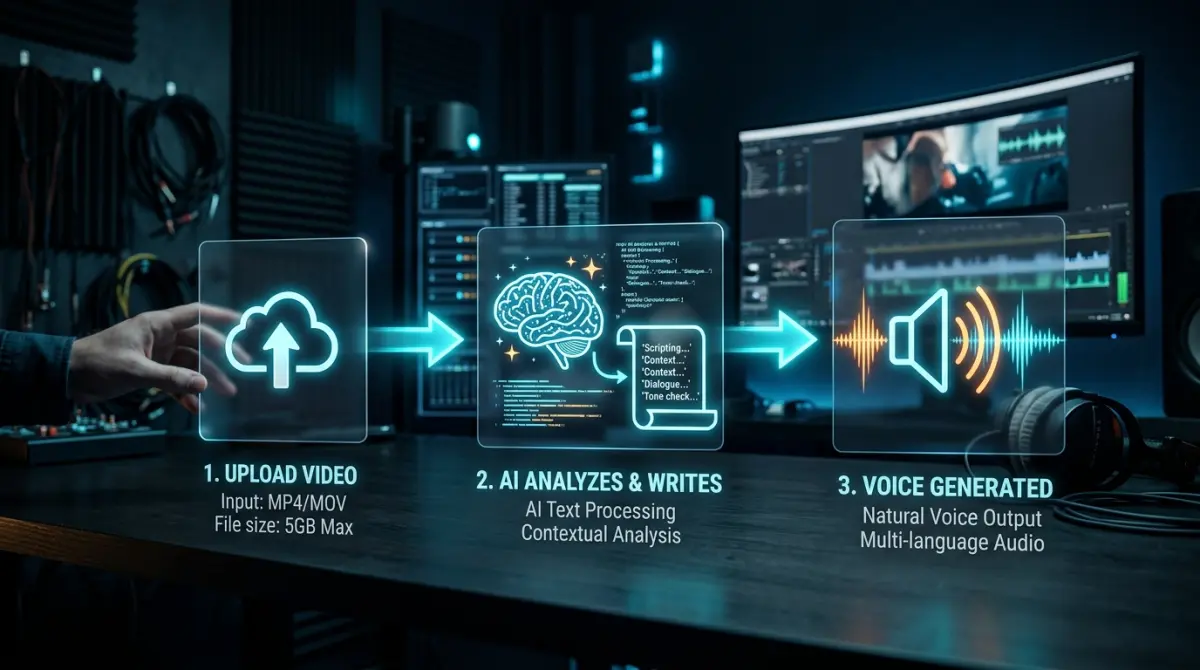
Modern AI voiceover systems combine several technologies. Understanding the pipeline helps you pick the right tool and get better output.
Text-to-Speech (TTS)
At the core, every AI voiceover tool uses a text-to-speech engine. You provide text, the model generates audio. Current neural TTS models handle pacing, emphasis, and breathing pauses without manual tuning.
The best engines in 2026 support:
- Voice cloning — upload a sample of your voice (or any voice you have rights to) and the AI reproduces it
- Multilingual output — generate narration in 30+ languages from a single model
- Emotion and style control — adjust tone from conversational to authoritative to energetic
- Real-time streaming — generate audio fast enough for live applications
Context-Aware Narration
Standalone TTS requires you to write the script first. A newer approach — used by tools built specifically for video — skips the manual scripting step entirely.
These systems analyze your video frame by frame, identify what's happening on screen (clicks, page transitions, UI elements), and generate narration that explains the action in real time. The result is a voiceover that stays perfectly synchronized with the visuals.
This is particularly powerful for screen recordings and tutorials, where the narration needs to match specific on-screen actions rather than just accompany generic footage.
Voice Quality Tiers
Not all AI voices are equal. Here's a rough hierarchy:
| Tier | Quality | Typical Use |
|---|---|---|
| Basic TTS | Robotic, monotone | Accessibility, internal docs |
| Standard Neural | Natural but detectable as AI | Social media, quick demos |
| Premium Neural | Nearly human, expressive | Professional tutorials, marketing |
| Voice Clone | Sounds like a specific person | Brand consistency, personal channels |
Most tools reviewed in this guide operate at the Premium Neural tier or above.
Types of AI Voiceover Tools
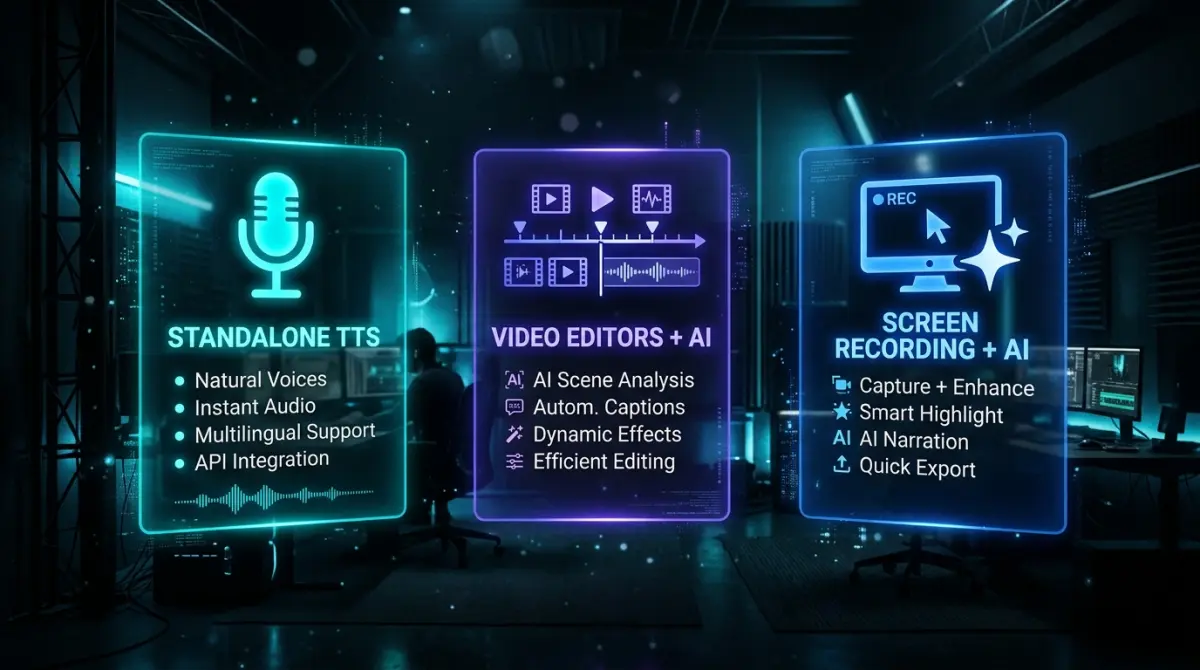
The market splits into three categories. Each serves different workflows.
1. Standalone TTS Platforms
These are pure text-to-speech engines. You paste a script, choose a voice, and download an audio file. You then import that audio into your video editor manually.
Best for: Podcasters, audiobook creators, and anyone who already has a polished script and a preferred video editor.
Limitation: No video awareness. You handle all timing and synchronization yourself.
2. Video Editors with AI Voice
Full video editing suites that include AI voiceover as one feature among many. You edit the video, add captions, and generate voiceover — all in one interface.
Best for: Content creators who need a complete editing workflow and want voiceover baked into the same tool.
Limitation: The AI voice is an add-on, not the core product. Voice quality and customization options vary.
3. Screen Recording Narration Tools
Purpose-built for turning silent screen recordings into narrated videos. These tools analyze what's happening in your recording and generate both the script and the voiceover automatically.
Best for: Software teams, educators, and anyone making tutorials or product demos from screen recordings.
Limitation: Focused specifically on screen content. Not designed for talking-head videos or cinematic footage.
If you're making tutorial content, you might also want to read our guide on how to make a tutorial video without a microphone.
Top AI Voiceover Tools Compared
Here are the leading tools in 2026, each with a distinct strength.
ElevenLabs — Best Voice Quality
ElevenLabs set the standard for AI voice quality. Their models produce some of the most natural-sounding speech available, with excellent support for voice cloning and multilingual output.
What it does well:
- Industry-leading voice naturalness and expression
- Voice cloning from short audio samples
- 29+ languages with native-quality pronunciation
- API access for developers building custom workflows
- Voice library with community-created voices
Where it falls short:
- No video editing — it's a TTS platform, not a video tool
- You write the script yourself
- Synchronizing audio to video requires a separate editor
Pricing: Free tier with limited characters. Pro starts at $5/month for 30,000 characters. Scale and Enterprise tiers for higher volume.
Best for: Creators who want the absolute best voice quality and are comfortable handling video editing separately.
Descript — Best All-in-One Video Editor
Descript combines video editing, transcription, and AI voiceover in a single app. Its signature feature is text-based editing — edit your video by editing the transcript, like a document.
What it does well:
- Edit video by editing text (delete a word from the transcript, the video cuts automatically)
- AI voice cloning ("Overdub") trained on your voice
- Built-in screen recording
- Filler word removal and studio sound enhancement
- Collaboration features for teams
Where it falls short:
- Voice cloning requires training with 10+ minutes of clean audio
- AI voices are good but not as natural as ElevenLabs for standalone TTS
- Desktop app can be resource-heavy on older machines
Pricing: Free tier available. Pro at $24/month includes AI features and 1 hour of transcription per month. Business tier at $33/month.
Best for: Video creators who want editing and voiceover in one tool, especially those who work with existing recordings that need cleanup.
Synthesia — Best for AI Avatars
Synthesia takes a different approach: instead of just voiceover, it generates a complete AI presenter. Choose an avatar, type your script, and get a video of a realistic digital human delivering it.
What it does well:
- 230+ AI avatars with natural lip-sync and gestures
- Custom avatar creation from a short video recording
- 140+ languages
- Built-in slide and screen recording integration
- Enterprise-grade compliance and security features
Where it falls short:
- The avatar approach doesn't suit every use case (tutorials, demos)
- Less flexibility for screen recording narration — the avatar takes center stage
- Higher price point than pure TTS tools
Pricing: Starts at $22/month (Starter). Enterprise plans with custom avatars priced individually.
Best for: Corporate training, HR onboarding, and internal communications where a human presenter adds credibility but filming isn't practical.
Vorec — Best for Screen Recording Tutorials
Worth knowing: Vorec is built specifically to turn silent screen recordings into narrated tutorial videos. Upload a recording, and the AI watches what happens on screen — every click, scroll, and page transition — then writes a narration script and generates voice audio that syncs with the action.
What it does well:
- Fully automatic: upload a silent recording, get a narrated video
- AI analyzes on-screen actions and writes the script (no manual scripting)
- Voice narration syncs precisely with clicks and transitions
- Built-in timeline editor for adjusting segments, timing, and voice
- Designed specifically for software tutorials, product demos, and walkthroughs
Where it falls short:
- Focused on screen recordings — not a general video editor
- Newer to the market than established tools like Descript
- Voice selection is growing but smaller than ElevenLabs' library
Pricing: Free tier with 200 credits. Pro at $9/month with 500 credits.
Best for: Anyone making software tutorials, product demos, or documentation videos who wants to skip scripting and voice recording entirely. See how it compares to traditional screen recorders in our Loom alternative with AI narration guide.
Murf AI — Best Voiceover Studio
Murf AI positions itself as a professional voiceover studio. It offers a large voice library with fine-grained controls for pitch, speed, emphasis, and pauses.
What it does well:
- 200+ voices across 20+ languages
- Granular controls: pitch, speed, pause duration, emphasis on specific words
- Video integration — import video and add voiceover in the same interface
- Voice cloning available on enterprise plans
- Chrome extension for quick voiceover generation
Where it falls short:
- Script writing is manual — no video analysis
- Voice quality is strong but a step below ElevenLabs on direct comparison
- The free tier is very limited
Pricing: Free trial available. Creator at $23/month. Business at $79/month with voice cloning.
Best for: Marketing teams and e-learning creators who need precise control over voiceover delivery and produce high volumes of narrated content.
How to Add a Voiceover to a Video (Step by Step)
If you already have a video — a screen recording, a demo, a webinar clip — and just need to add a voiceover to it, here is the fastest workflow in 2026. It takes about ten minutes and needs no microphone.
- Have your video ready. Any format works: a screen recording from QuickTime or OBS, a Loom export, or a clip you shot earlier. For screen-based content, keep it silent — you will not be talking over it.
- Upload it to an AI voiceover tool. With a screen-recording narration tool like Vorec, you drop the file in and the AI watches what happens on screen instead of asking you for a script.
- Let the AI write the script (or paste your own). Tools built for video generate narration matched to the on-screen action automatically. Pure text-to-speech tools like ElevenLabs or Murf require you to paste a script you have written.
- Pick a voice and generate. Choose the tone — calm and instructional for tutorials, upbeat for marketing — and the tool produces the audio.
- Sync the voice to the visuals. This is the step people underestimate. If the audio and action drift apart, viewers rewind. Vorec times each sentence to the exact click or transition and uses freeze-sync to pause the frame when a line needs more room, so the two never fall out of step.
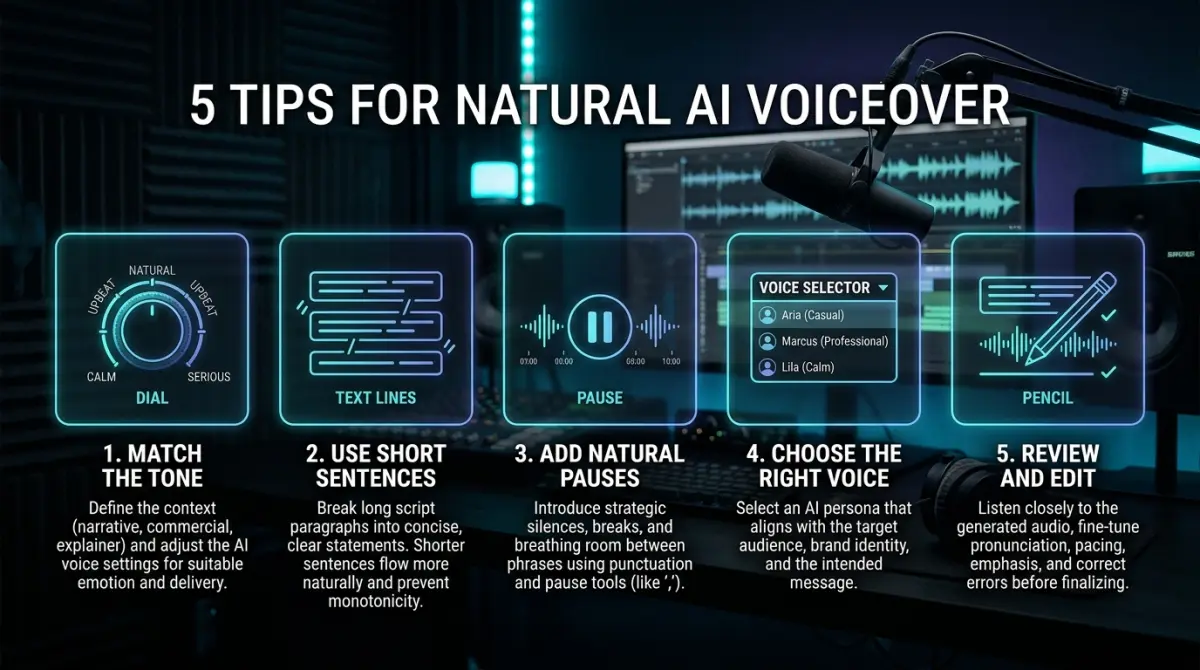
- Review, tweak, and export. Read the generated script, adjust any wording, regenerate only the segments you changed, and export the finished video.
Adding a voiceover in a traditional editor (iMovie, Premiere, CapCut) works too, but you record your own voice against the timeline manually — expect several takes and manual alignment. The AI route skips the microphone, the retakes, and the alignment entirely, which is why it has become the default for tutorials and demos. For the no-microphone method in depth, see our guide on how to make tutorial videos without a microphone.
When to Use AI Voiceover vs. Human Voiceover
AI voiceover is powerful, but it's not always the right choice. Here's a practical framework.
Choose AI Voiceover When:
- Volume is high — You produce 10+ videos per week and recording voice for each is unsustainable
- Speed matters — You need the video published today, not after scheduling a recording session
- Budget is tight — Professional voice actors charge $100-500+ per finished minute
- Content updates frequently — Software tutorials go stale fast; re-narrating with AI takes minutes
- Multiple languages needed — Translating and re-recording in 5 languages multiplies cost; AI handles it natively
- Consistency is important — Same voice, same tone, every video, without variation from session to session
Choose Human Voiceover When:
- Emotional connection is critical — Brand storytelling, fundraising, high-stakes presentations
- The voice IS the brand — Think podcast hosts or YouTube creators whose voice is their identity
- Nuance is complex — Sarcasm, humor, dramatic timing that current AI still struggles with
- Audience expects it — Premium training courses where perceived quality directly affects pricing
- Regulatory requirements — Some industries require human-reviewed content
The Hybrid Approach
Many teams in 2026 use both. AI handles the bulk of tutorial and documentation content. Human voiceover is reserved for flagship marketing videos and course content where the voice needs to carry emotion.
For screen recording tutorials specifically, AI voiceover is now the default choice. The combination of automatic script generation and voice synthesis means a 5-minute tutorial that used to take 2 hours (script, record, edit, re-record) now takes 10 minutes. Learn more about adding AI voice to screen recordings.
How to Get Natural-Sounding AI Voiceover
Even with premium AI voices, output quality depends on how you use the tool. These tips apply across all platforms.
1. Write for Speech, Not for Reading
If you're writing your own script (rather than using a tool that generates it automatically), write the way people talk:
- Use contractions ("you'll" not "you will")
- Keep sentences short (under 20 words)
- Read your script aloud before feeding it to the AI — if you stumble, simplify
- Use em dashes and ellipses to create natural pauses
2. Break Long Scripts into Segments
Don't paste a 2,000-word script as a single block. Break it into segments of 2-4 sentences. This gives you:
- Better control over pacing
- Easier editing (re-generate one segment without redoing the whole video)
- More natural pauses between sections
3. Match Voice to Content
A high-energy marketing voice sounds wrong on a developer tutorial. A calm instructional voice feels flat on a product launch video. Most tools offer voice previews — spend 5 minutes testing before committing.
General guidelines:
- Tutorials and documentation: Calm, clear, moderate pace
- Marketing and product demos: Energetic, confident, slightly faster
- Training and onboarding: Warm, patient, deliberate
4. Control Pronunciation
AI voices sometimes mispronounce product names, technical terms, or acronyms. Most tools offer pronunciation overrides:
- Phonetic spelling: Write "koo-ber-NET-eez" instead of "Kubernetes" in the script
- SSML tags: Some platforms support Speech Synthesis Markup Language for precise control
- Custom dictionaries: ElevenLabs and Murf let you save pronunciation rules
5. Add Post-Processing
Raw AI audio benefits from light processing:
- Normalize volume so narration levels are consistent across segments
- Add subtle background music (at 10-15% volume) to fill micro-pauses and make the voice feel less isolated
- Match audio levels between narration and any existing video audio (clicks, UI sounds)
AI Voiceover Tools Comparison Table
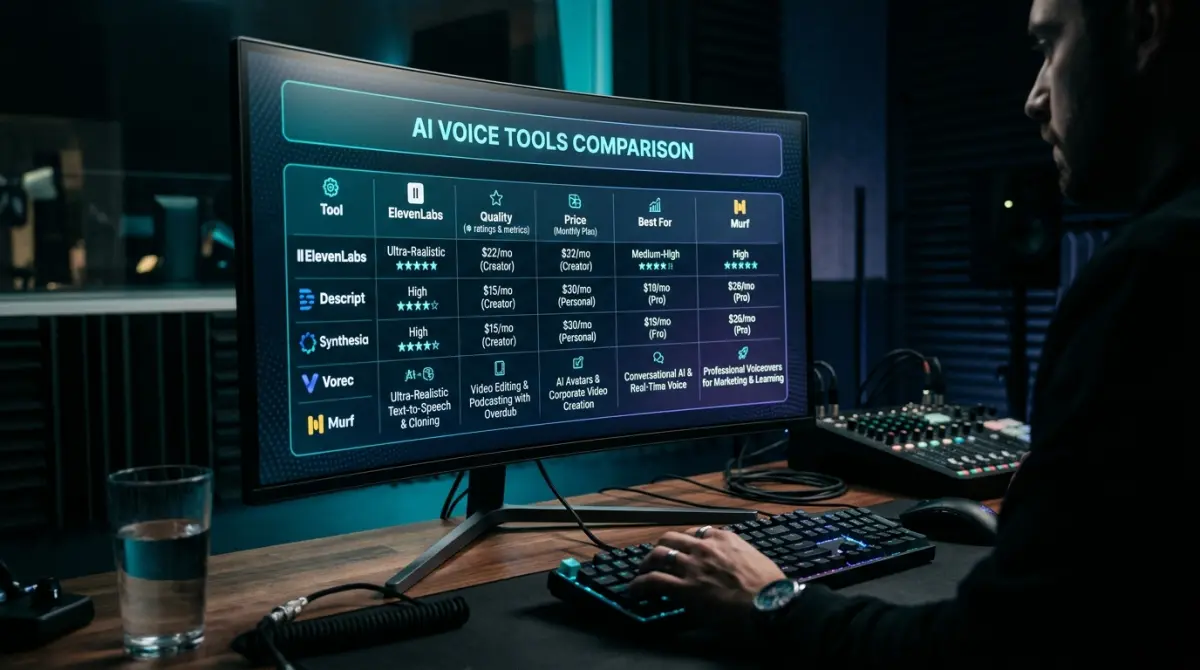
| Tool | Best For | Auto Script | Video Editor | Voice Clone | Languages | Starting Price |
|---|---|---|---|---|---|---|
| ElevenLabs | Voice quality | No | No | Yes | 29+ | Free / $5/mo |
| Descript | All-in-one editing | No | Yes | Yes | 1 (English) | Free / $24/mo |
| Synthesia | AI avatars | No | Yes | No | 140+ | $22/mo |
| Vorec | Screen recordings | Yes | Yes | No | 20+ | Free / $9/mo |
| Murf AI | Voiceover studio | No | Basic | Enterprise | 20+ | Free / $23/mo |
Key takeaways from the comparison:
- If voice quality is your top priority and you already have a script, ElevenLabs leads the field
- If you want one tool for everything (editing, transcription, voiceover), Descript is the most complete
- If you need an AI presenter on camera, Synthesia is the only real option
- If you make screen recording tutorials and want the fastest path from recording to narrated video, Vorec automates the entire pipeline
- If you need precise voiceover controls for professional production, Murf AI gives you the most knobs to turn
Your AI Voiceover Checklist
Before you commit to a tool or workflow, run through this checklist:
- [ ] Define your content type — Are you narrating screen recordings, marketing videos, training content, or something else?
- [ ] Decide on scripting — Will you write scripts manually or do you want AI to generate them from your video?
- [ ] Test voice quality — Use free tiers to compare voices across 2-3 tools with your actual content
- [ ] Check language support — If you need multilingual output, verify quality in each target language (not just availability)
- [ ] Evaluate the editing workflow — How much post-production do you need? Does the tool handle it or do you need a separate editor?
- [ ] Calculate true cost — Factor in time saved, not just subscription price. A $9/month tool that saves 10 hours/month is worth far more than its sticker price
- [ ] Plan for scale — If you're producing 5 videos now but expect 50 in six months, pick a tool with volume pricing
- [ ] Test with your audience — Share an AI-narrated video with a small group before rolling out widely. Most viewers can't tell the difference, but your specific audience may have preferences
Conclusion
AI voiceover for videos in 2026 is fast, affordable, and genuinely good. The technology has crossed the threshold where the average viewer cannot reliably distinguish AI narration from a human recording.
The right tool depends on your workflow. For standalone voice quality, ElevenLabs remains the benchmark. For all-in-one video editing, Descript covers the most ground. For screen recording tutorials — the fastest-growing category — Vorec eliminates manual scripting entirely by watching your recording and narrating what it sees.
Start with a free tier. Test with real content. Most creators find that AI voice over for videos doesn't just save time — it fundamentally changes how much content they can produce.
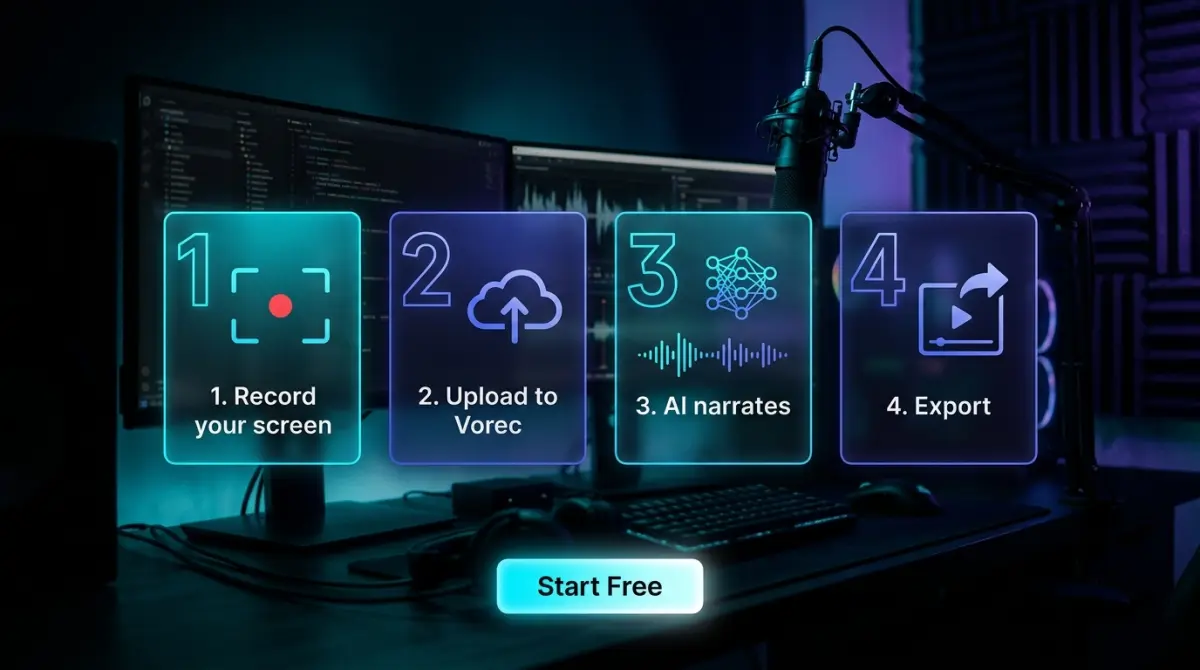
Add a voiceover to your video without a microphone. Upload a screen recording to Vorec and get a narrated video — the AI writes the script and syncs the voice to every action. Start free with 200 credits.