Best Screen Recorder with AI Narration (2026)
Vorec Team · 2026-04-03 · 8 min read
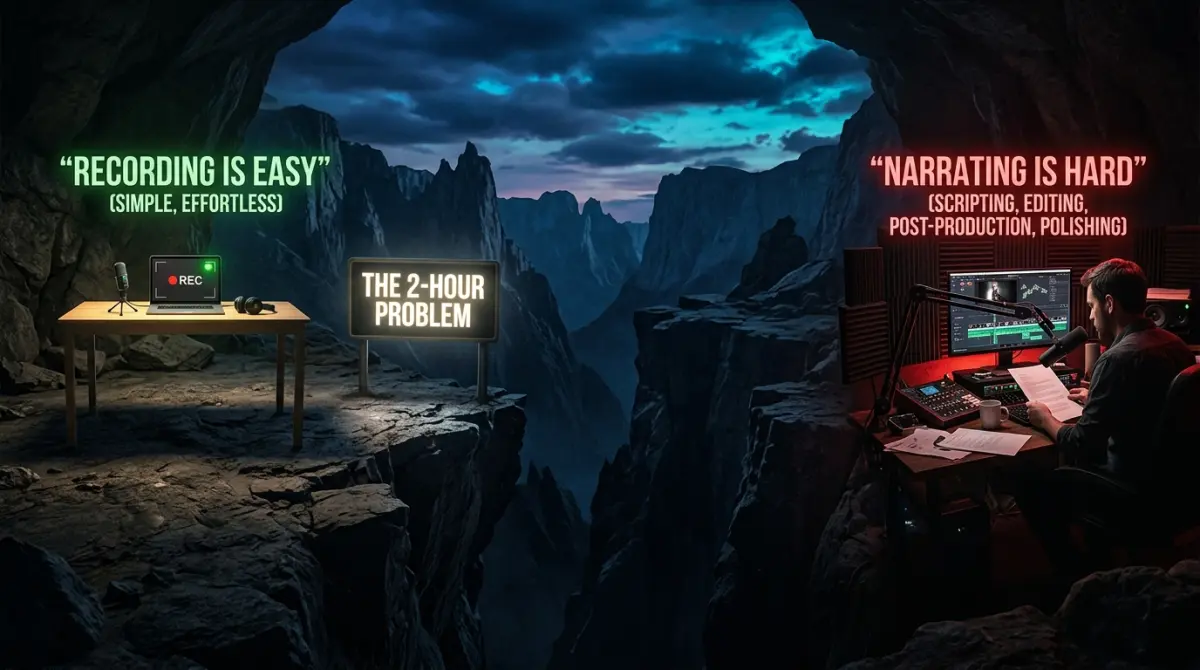
Screen recording has never been easier. Every operating system ships with a built-in recorder, and dozens of free tools can capture your screen in seconds. But here is the dirty secret of screen recording: the recording is the easy part.
The hard part is everything that comes after. Writing a script. Setting up a microphone. Recording a voiceover without stumbling. Editing the audio. Syncing narration to on-screen actions. Adding captions. Exporting. What should take five minutes somehow eats an entire afternoon.
This is the gap that screen recording software with AI narration fills. You record your screen silently, upload the video, and AI handles the rest -- writing the script, generating the voiceover, syncing it to your actions, and producing a finished tutorial.
The Screen Recording Problem Nobody Talks About
If you have ever tried to create a tutorial video, onboarding walkthrough, or product demo, you know the pain. The actual screen recording takes two minutes. Then you spend the next two hours on:
- Writing a script that matches what happens on screen
- Setting up audio -- finding a quiet room, testing your microphone, adjusting levels
- Recording voiceover -- and re-recording when you stumble, cough, or lose your place
- Editing audio -- removing ums, ahs, dead air, and background noise
- Syncing narration to video -- making sure your words line up with the clicks and actions
- Adding captions -- because accessibility matters and viewers watch on mute
- Exporting and encoding -- getting the right format, resolution, and file size
Most screen recordings never get narrated at all. They sit in a folder as silent videos that nobody watches, because a silent screen recording without context is nearly useless. The viewer has no idea what they are looking at, why you clicked something, or what they should do next.
Traditional screen recording software solved the capture problem years ago. What it never solved was the production problem.
What "Screen Recording with AI Narration" Actually Means
AI-narrated screen recording flips the traditional workflow. Instead of recording your voice while you record your screen, you record silently and let AI handle the narration afterward.
Here is what happens under the hood:
- Visual analysis -- AI watches your recording frame by frame, identifying every click, scroll, menu selection, text input, and page navigation
- Script generation -- Based on what it sees, AI writes a natural narration script that explains each action in context
- Voice synthesis -- The script is converted to speech using AI voices that sound natural, with proper pacing and intonation
- Automatic sync -- Each narration segment is timed to match the exact moment the action occurs on screen
The result is a professionally narrated tutorial video from a silent screen recording. No microphone. No script writing. No audio editing.
The Old Way vs. The New Way
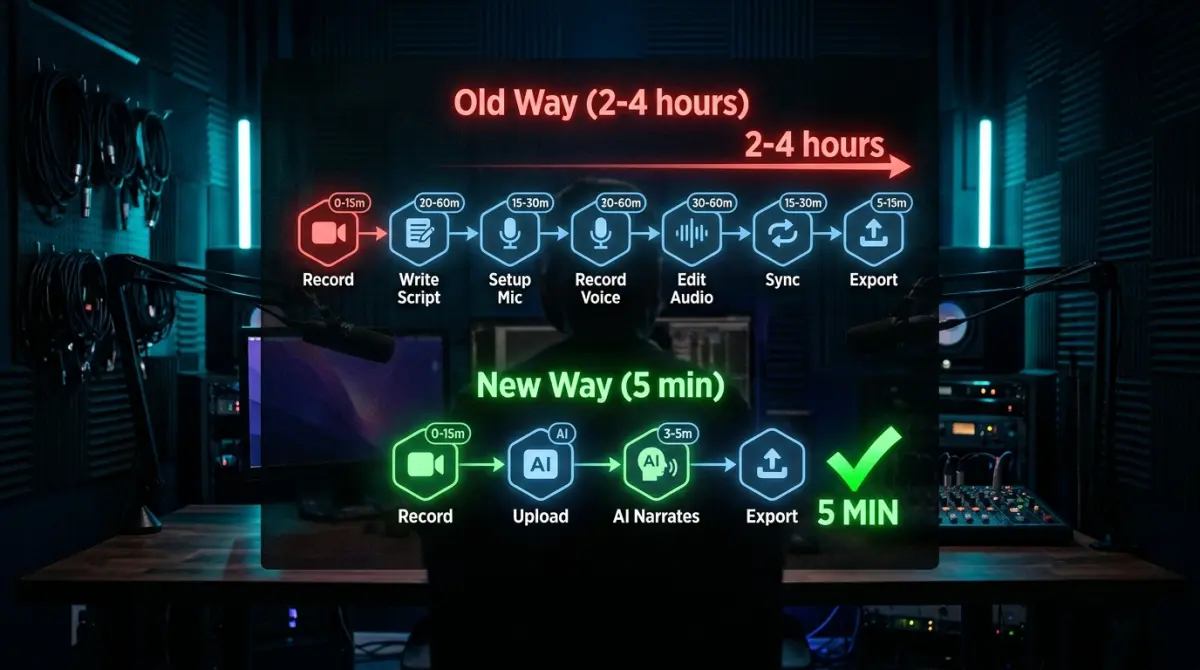
Here is what creating a narrated screen recording looks like with traditional tools versus AI narration:
Traditional Workflow (2-4 Hours)
- Plan what you will record and write a rough script
- Set up your microphone and test audio levels
- Record your screen while narrating live (restart when you make mistakes)
- Import into a video editor
- Edit out mistakes, pauses, and filler words
- Re-record sections where the audio is unclear
- Sync audio to video manually
- Add captions manually or pay for transcription
- Export and compress
AI Narration Workflow (5-10 Minutes)
- Record your screen silently (use any recorder)
- Upload the recording
- AI analyzes and generates narration
- Review the script, make edits if needed
- Choose a voice and export
The difference is not incremental -- it is a completely different category of effort. You go from a multi-hour production process to something closer to sending an email.
How Vorec Works: Step by Step
Worth knowing: Vorec is screen recording software built specifically for this workflow. Here is exactly how it works:
Step 1: Record Your Screen
Use any screen recorder you already have. QuickTime on Mac, Xbox Game Bar on Windows, OBS, or any browser extension. Vorec does not lock you into a proprietary recorder -- it works with any video file.
Record your workflow silently. No need to narrate, no microphone required. Just do the thing you want to show.
Step 2: Upload the Silent Recording
Drag and drop your video into Vorec. It accepts MP4, WebM, and MOV files.
Step 3: AI Analyzes Every Action
This is where the magic happens. Vorec's AI watches your entire recording and identifies:
- Every click and where it landed
- Text you typed
- Menus you opened
- Pages you navigated to
- Scrolling and selections
- UI changes and transitions
It builds a complete map of everything that happened in your recording.
Step 4: Review and Edit the Script
AI generates a narration script broken into segments, each tied to a specific moment in the video. You can:
- Edit any segment's text -- tweak wording, add context, fix terminology
- Adjust timing -- move segments earlier or later on the timeline
- Add or remove segments -- insert explanations the AI missed, or remove redundant ones
- Change the narration style -- switch between tutorial, conversational, or professional tones
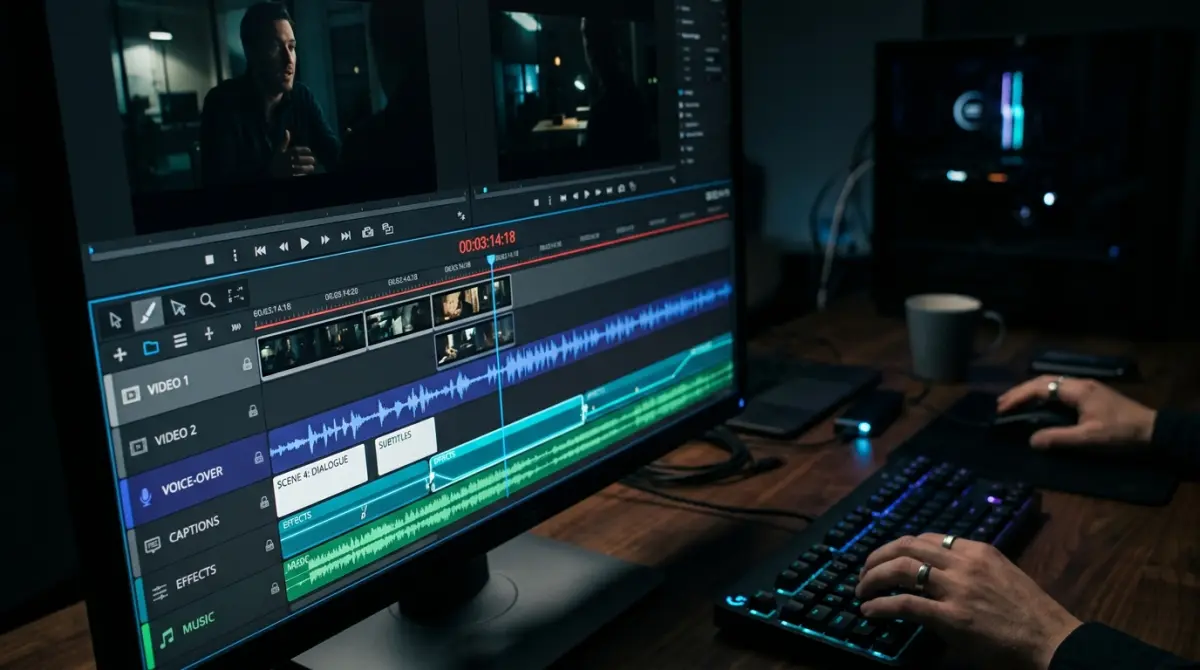
The script editor shows the video alongside the text, so you can see exactly what the viewer will experience.
Step 5: Choose a Voice
Pick from multiple AI voices. Preview each one with your actual script before committing. Voices are natural-sounding with proper pacing -- not the robotic text-to-speech you might expect.
Step 6: Export with Everything
Export your finished video with:
- Synchronized voiceover -- narration timed to each action
- Captions -- automatically generated from the script, fully styled
- Visual effects -- zoom into clicks, spotlight important areas, blur sensitive info
- Background music -- optional ambient tracks that auto-duck under narration
Bonus: Get a Written Article Too
Vorec can also generate a step-by-step written article from the same analysis. One screen recording gives you both a narrated video and a help doc -- two content formats from a single recording session.
Learn more about the full tutorial creation process in our guide on how to make a tutorial video.
Who Is This For?
AI-narrated screen recording is not a niche tool. Anyone who records their screen regularly can benefit.
Developers and DevRel Teams
You build tools that need documentation. Recording a silent demo of your API, CLI, or dashboard takes two minutes. Vorec turns it into a narrated walkthrough your users can actually follow. Ship docs faster without becoming a video production team.
Customer Support Teams
Stop writing 15-step support articles with screenshots. Record yourself solving the customer's problem, upload it, and send them a narrated video. Resolution time drops. Customer satisfaction goes up. Your support team stops dreading "how do I..." tickets.
Product and Marketing Teams
Feature demos, release announcements, and sales enablement videos used to require a video producer. Now anyone on the team can record a feature walkthrough and have a polished demo ready in minutes. Perfect for fast-moving teams that ship weekly.
Educators and Course Creators
If you create educational content, you know the audio recording grind. AI narration lets you focus on the teaching -- showing the right workflow on screen -- without worrying about microphone technique or audio editing.
Internal Teams and Onboarding
New hire needs to learn your internal tools? Record the workflow once, let AI narrate it, and you have a reusable onboarding video. Beats scheduling a live walkthrough every time someone joins.
Real Use Cases
Developer onboarding video: A senior engineer records themselves setting up the local dev environment. Upload to Vorec. Five minutes later, every new hire has a narrated setup guide instead of a stale wiki page.
Feature demo for sales: Product manager records the new dashboard feature for the sales team. AI narrates each click. Sales has a polished demo clip for their next call -- no video editor needed.
Customer support walkthrough: Support agent records the fix for a common billing issue. The narrated video goes into the help center. Ticket volume for that issue drops.
Course module: An instructor records a Figma design workflow. AI narrates each step. The written article becomes the companion text. One recording, two deliverables.
For more on adding narration to screen recordings, check out our detailed guide.
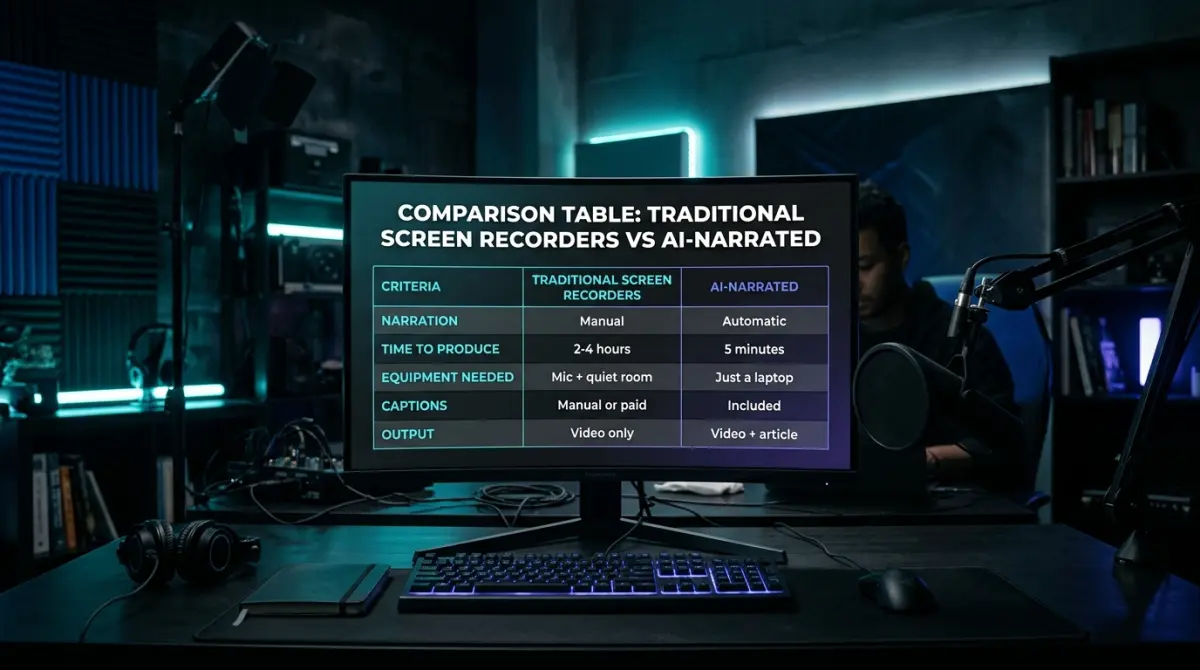
Traditional Screen Recorders vs. AI-Narrated
| Feature | Traditional Recorders | Vorec (AI Narration) |
|---|---|---|
| Screen capture | Yes | Use any recorder |
| Live narration | You talk while recording | Not needed |
| Post-recording narration | Manual voiceover | AI-generated |
| Script writing | You write it | AI writes it |
| Audio editing | Manual | None required |
| Captions | Manual or paid service | Automatic |
| Visual effects (zoom, blur) | Separate editor | Built-in |
| Written article | Separate effort | Auto-generated |
| Time to produce | 2-4 hours | 5-10 minutes |
| Microphone required | Yes | No |
Traditional screen recorders like OBS, Loom, and Camtasia are great at capture. Vorec is built for what comes after capture -- the narration, production, and publishing that turns a raw recording into content people actually watch.
See how Vorec compares to other tools in our Loom alternatives guide.
Quick-Start Guide
Ready to try it? Here is how to go from zero to narrated video in under ten minutes:
- Record your screen using any tool (QuickTime, OBS, browser extension). Keep it under 10 minutes for best results. Do not narrate -- just do the workflow silently.
- Go to vorec.ai and create a free account. You get 200 credits to start -- enough for several videos.
- Create a new project and upload your recording. Drag and drop or click to browse.
- Click "Generate" and wait for AI to analyze your video. This typically takes 30-60 seconds.
- Review the narration in the timeline editor. Edit any text that needs tweaking. Adjust timing if needed.
- Pick a voice from the voice selector. Preview it with your script.
- Add effects -- zoom into click areas, add captions, spotlight important sections.
- Export your finished video. Download it or share a link.
That is it. Your silent screen recording is now a narrated tutorial with professional voiceover, captions, and effects.
Stop Recording Your Voice. Start Recording Your Screen.
The bottleneck in creating tutorial videos was never the screen recording. It was everything that came after -- the scripting, narrating, editing, and syncing that turned a simple task into a production.
Screen recording software with AI narration removes that bottleneck entirely. Record silently, upload, and let AI handle the production. You get a narrated video, captions, visual effects, and even a written article -- all from a single silent recording.
Try Vorec free and turn your next screen recording into a narrated tutorial in minutes, not hours.