Camtasia vs Loom (2026): Polish or Speed?
Vorec Team · 2026-09-12 · 6 min read
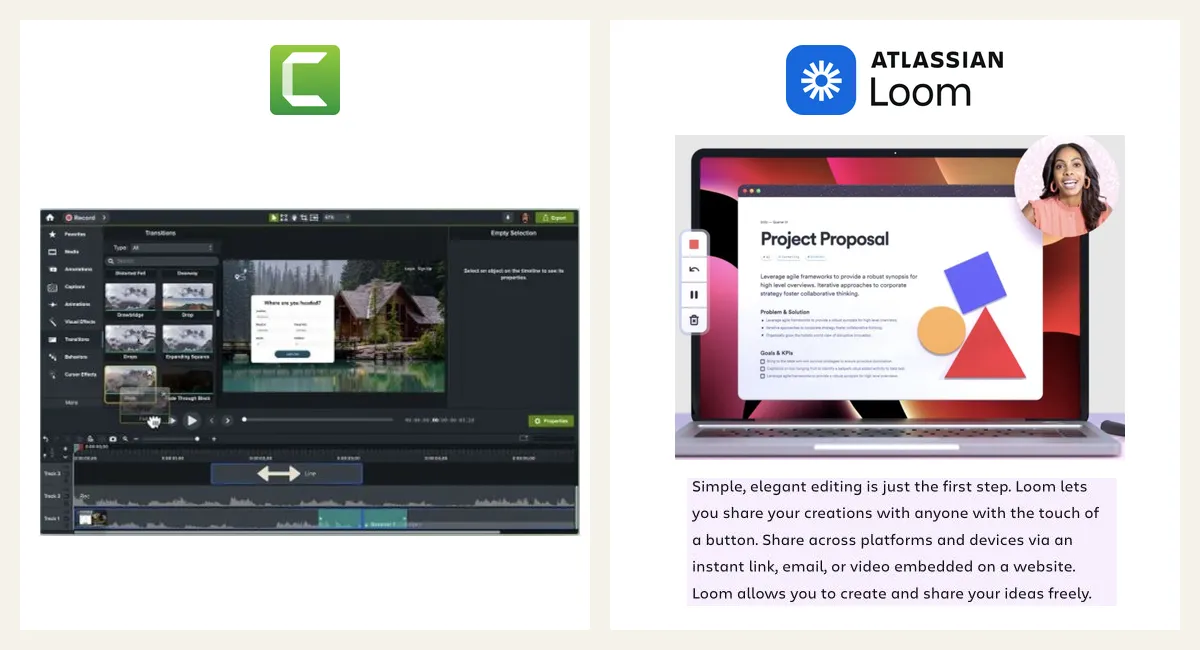
Camtasia and Loom get compared constantly, which is strange, because they were built for opposite jobs. Camtasia is a video editor. Loom is a send button. Teams that confuse the two end up either editing a two-minute status update for an hour, or shipping a customer-facing tutorial that looks like a hurried webcam call.
Here is the split, and the pricing as it actually stands in 2026.
The 30-Second Verdict
- Pick Loom for anything ephemeral: standups, code reviews, bug reports, "here is what I meant" replies. Recording is the deliverable.
- Pick Camtasia for anything durable: onboarding, help centres, courses, anything watched more than once by people who did not ask for it.
- Pick neither if you want durable-quality output without a person editing it — the gap both leave open, addressed at the end.
The Real Difference: Is the Recording the Final Product?
Loom's design assumes yes. You hit record, talk, stop, and the link is already live. The value is the removal of every step between having something to say and someone hearing it. Trimming exists, but heavy editing fights the product.
Camtasia assumes no. The recording is raw material. You bring it onto a timeline and build: zoom-and-pan onto the button you are describing, callouts, captions, quizzes, a cleaned-up audio track.
That is why "Camtasia vs Loom" is rarely a real decision. The honest question is how long the video needs to stay useful. Under a week, Loom. Over a year, Camtasia.
Pricing in 2026
| Free tier | Entry paid | Higher tiers | |
|---|---|---|---|
| Loom | ✅ generous, capped video length | ~$15/user/mo | Business / Enterprise per seat |
| Camtasia | Free Camtasia Online / desktop trial | $39/yr Starter (watermarked editor) | $179.88/yr Essentials · $249/yr Create · $599/yr Pro |
Prices checked 12 September 2026. Camtasia figures are US individual annual prices; Starter includes a watermarked editor. Essentials and above provide watermark-free editing. Team and regional prices differ. TechSmith pricing.
The important change: Camtasia is subscription-only now. TechSmith ended perpetual licences in Fall 2024. Existing perpetual keys are grandfathered on that version, but every new seat is an annual subscription. For a lot of long-time users that reframed Camtasia from "buy once" to "another renewal," which is exactly why price complaints have risen.
Loom's cost scales per person. Camtasia's scales per person too, but only for the people who actually edit — usually one or two. Compare the actual number of recording and editing seats; team size alone does not establish which subscription costs less.
Head-to-Head
Speed
Loom finishes when you stop talking. Camtasia finishes when you decide it is finished.
Loom wins, and nothing about Camtasia is trying to compete here.
Output quality
Camtasia's zoom, callouts and captions are the difference between a recording of a screen and a video that teaches. On a 1080p screen recording played at half size, the unzoomed version is often literally unreadable.
Camtasia wins.
Audio and narration
Loom's core workflow captures a spoken update as you record. Camtasia supports recorded or imported audio, and Create / Pro add AI scripts and generated narration. Camtasia offers more production control, including a route that does not require recording your own voice. TechSmith plan features.
Sharing and analytics
Loom is built around the link: instant URL, view tracking, comments, reactions, embedding. Camtasia can export a file, while bundled Screencast and Camtasia Online provide hosting and sharing options.
Loom wins, decisively.
Reuse and maintenance
A Loom recording is hard to update — the fix is usually re-recording. A Camtasia project is a timeline you can reopen when the UI changes next quarter.
Camtasia wins, and this is underrated. Training content dates fast.
Feature Matrix
| Loom | Camtasia | |
|---|---|---|
| Record and share in one step | ✅✅ | ❌ |
| Timeline editing | Minimal | ✅✅ |
| Zoom / callouts / annotations | Limited | ✅✅ |
| Quizzing and LMS | ❌ | ✅ |
| View analytics and comments | ✅✅ | Sharing / feedback through Screencast |
| Editable months later | ❌ | ✅ |
| Generated narration | Compare current plan | ✅ Create / Pro |
| Free tier | ✅ | Camtasia Online; desktop trial |
Most Teams Need Both — And That Is the Problem
In practice, teams buy Loom for everyone and Camtasia for the one person who makes real tutorials. It works, but it creates the bottleneck everyone recognises: a queue of recordings waiting on the single colleague who knows the editor.
That bottleneck is not a tooling gap between Loom and Camtasia. It is a gap underneath both: producing durable, polished, narrated video without a person doing the editing.
Vorec addresses that directly. Upload a silent screen recording and the AI detects every click, writes narration matched to what happens on screen, and generates the voiceover — no microphone, no timeline. Freeze-sync holds the frame when a sentence needs more time than the recording gives it, so narration never drifts ahead of the action. The same recording also yields a written help article, and narration can be regenerated in other languages without re-recording.
Plans start at $9/month with a free 200-credit trial (trial exports carry a watermark).

Who Should Pick What
Choose Loom if: most videos are internal, disposable, and the point is speed. Asynchronous updates instead of meetings.
Choose Camtasia if: videos are customer-facing or training assets, you need quizzing or LMS tracking, and someone will own the editor.
Choose a narration tool if: you need Camtasia-grade output at Loom-grade effort, or nobody wants to be the narrator.
Bottom Line
Loom and Camtasia are not competitors; they are two ends of a spectrum with a genuine gap in the middle. Loom removes the work and accepts rough output. Camtasia produces excellent output and charges you an afternoon for it.
Pick by lifespan. Anything watched once, Loom. Anything watched for a year, Camtasia — unless you would rather not do the editing at all, in which case neither is the answer.
See also our Loom alternatives roundup and the Camtasia alternative guide.
Polished tutorials without the timeline? Upload a silent screen recording to Vorec and get a narrated video plus a written guide. Start free with 200 credits.