Storylane Pricing 2026: The Starter-to-Growth Cliff
Vorec Team · 2026-09-18 · 8 min read
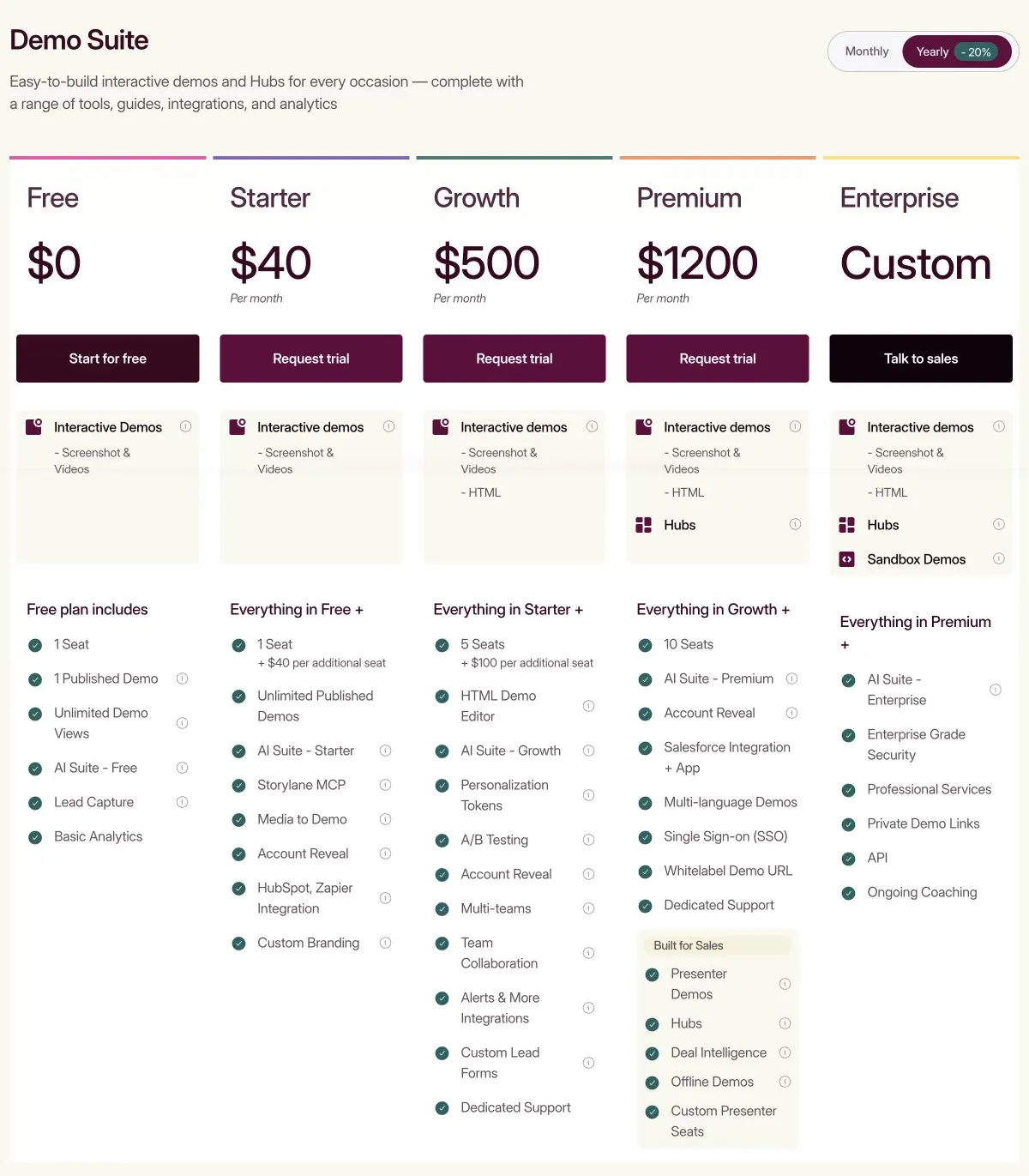
Storylane's price list has a cliff in it. Starter is $480 a year. The next tier up, Growth, is $6,000 — twelve and a half times more. There is nothing between them.
That gap is the whole decision, and it catches people out because Starter looks like a normal entry plan until you need one feature that sits on the other side of it.
Everything below was verified on Storylane's plans page with both billing states selected, on 17 September 2026. Note that `storylane.io/pricing` redirects to `/plans`. Prices change; check before you buy.
The Short Version — Demo Suite
| Plan | Yearly | Per year | Monthly | Seats included |
|---|---|---|---|---|
| Free | $0 | $0 | $0 | 1 |
| Starter | $40/mo equiv | $480 | $50/mo | 1 |
| Growth | $500/mo equiv | $6,000 | $625/mo | 5 |
| Premium | $1,200/mo equiv | $14,400 | $1,500/mo | 10 |
| Enterprise | Custom | Custom | Custom | — |
These are package prices, not per-user prices. Growth is $6,000 a year for a bundle that includes five seats — it is not $500 per person. The included seats are an allocation, not a requirement: nothing we found documents a hard eligibility gate forcing you to have five actual people, and we did not test checkout.
Storylane also runs a separate product, RepX, on completely different billing — covered further down. Do not read Demo Suite prices as RepX prices.
The $480-to-$6,000 Cliff
Starter gets you unlimited published demos, the Starter AI Suite, MCP, Media to Demo, Account Reveal, HubSpot and Zapier, and custom branding — on one seat.
Growth is where these begin: HTML demos and the HTML editor, personalization tokens, A/B testing, multiple teams and the collaboration features that go with them, alerts and wider integrations, custom lead forms, and dedicated support.
So the cliff is not about volume. Storylane's own pricing FAQ states that demo-view volume does not affect pricing — you will not be pushed up a tier by traffic. You cross it because you need HTML-based demos, A/B testing, or Storylane's multi-team collaboration features — note that Starter can already add creator seats and free reviewers, so this is about those specific features rather than about having colleagues. If you need none of those, Starter at $480 may hold for a long time.
There is a startup discount for bootstrapped, pre-seed and seed companies on Growth and Premium. Storylane does not publish the percentage, so ask before assuming it closes the gap.
Extra Seats: Read The Label Carefully
Storylane's cards show additional seats as Starter +$40 and Growth +$100. Those figures are displayed identically on both the annual and monthly cards — the monthly card does not switch the add-seat label to a monthly-equivalent number.
Read annually, that means roughly +$480 per extra Starter seat per year and +$1,200 per extra Growth seat per year. We are quoting the labels as shown and flagging the ambiguity rather than quietly reinterpreting them: confirm the exact add-seat charge for your billing period at checkout. Premium's extra-creator price is not published at all.
A billing trap worth knowing before you scale down. Per Storylane's billing documentation, deleting a team member does not reduce what you are billed — you have to separately lower the seat count under Manage seats. Seat changes prorate immediately. Starter cancellation is self-serve; Growth, Premium and Enterprise require contacting support.
Not every internal person needs a paid seat. Per Storylane's team documentation, Starter and above include free viewer seats for viewing and commenting, without creation, editing or sharing rights. Do not price your whole review chain at creator rates.
What Free Actually Includes
Free is one published demo, one seat, with unlimited demo views. It covers screenshot and video demos, lead capture, basic analytics and the Free tier of the AI Suite.
The important nuance: the cap is on published demos, not on how much you can ever create. Storylane's billing documentation describes a downgrade as letting you choose one demo to remain published — which means the constraint is what is live, not what exists. We could not verify whether drafts are unlimited, so do not plan around that.
AI Is Not Uniformly Unlimited
AI allowances are separate from the published-demo limits, and the numbers live in the docs rather than on the pricing page.
AI avatar minutes per month, per Storylane's AI demo-creation documentation:
| Plan | Avatar minutes/month |
|---|---|
| Free | 2 |
| Starter | 20 |
| Growth | 125 |
| Premium | 250 |
| Enterprise | Unlimited |
Only generated avatar minutes count against this, and a generation you reject still counts. Playback is unlimited.
Separately, Media to Demo and Video to Demo are credit-metered, and per Storylane's recording documentation the exact per-plan credit allowances were still being finalised when we checked. So "unlimited published demos" on Starter does not mean unlimited AI conversions. If AI conversion volume is central to your use, ask for the current numbers in writing.
Storylane does have voiceovers and text-to-speech, audio upload, AI guide creation and translation — the documentation describes 25+ voiceover languages with 60+ voices and 27+ text-translation languages. Per-tier voiceover quotas are not published, so we are not quoting any.
Exports, And One Thing Not To Confuse
Per Storylane's export documentation, demos export as GIF, MP4, PDF, Word, Markdown, copyable SOP text, and offline demos. GIF and MP4 lose interactivity, and offline viewing does not capture analytics. No resolution ceiling is published.
Do not confuse a white-label demo URL with removing the watermark. The white-label URL is a Premium feature, but per Storylane's branding documentation any paid plan can remove the watermark. Those are different things and it is easy to over-read the Premium row.
RepX Is Priced Completely Differently
Storylane's plans page has a second tab. RepX is billed on monthly visitors, not seats:
| RepX plan | From | Monthly visitors |
|---|---|---|
| Growth | $2,000/mo | up to 20,000 |
| Premium | $3,000/mo | up to 60,000 |
| Enterprise | Custom | 60,000+ |
These are "from" prices with no annual toggle or commitment terms published, so a 12-month figure is simple multiplication rather than a quoted annual invoice. There is a 30-day RepX trial. Growth covers voice and text, playbooks, CRM and unlimited screenshot/video interactive demos; Premium adds avatars, visitor de-anonymisation, a CSM and HTML demos; Enterprise adds a custom agent, SSO/SAML, multivariate testing and Hubs.
Two cautions. Older articles cite 10,000 and 40,000 visitor limits — those are stale; the current page shows 20,000 and 60,000. And the Demo Suite FAQ line about demo views not affecting pricing applies to Demo Suite, not to a product whose entire price is visitor volume.
Is Storylane Worth It?
Yes, if interactive product demos are a revenue channel and you are past the point of one person making them. Growth and Premium are priced for a demand-gen function, and the HTML editing, A/B testing and personalization are what you are buying.
Yes, at Starter, if you are one person making guided demos. $480 a year with unlimited published demos is genuinely reasonable, provided none of your must-haves sit above the cliff.
Reconsider if you would be buying Growth for one feature. Twelve and a half times the price for HTML demos or A/B testing is a large step; price the alternative of staying on Starter and solving that one need elsewhere.
Check the AI allowances before signing. Avatar minutes are tiered and conversion credits were unsettled when we checked.
How It Compares
| Entry paid (annual) | Notable | |
|---|---|---|
| Storylane | $480/yr | Interactive demos; large step to the next tier |
| Supademo | see our Supademo pricing breakdown | Interactive demos, separate AI agent credits |
| Vidyard | $708/seat/yr | See our Vidyard pricing breakdown |
| Vorec | $9/mo | Narrated video from a silent recording, plus a written article |
Formats differ, so this is orientation rather than like-for-like.
Where Vorec Fits
Storylane makes interactive demos — a prospect clicks through a replica of your product at their own pace. For a sales motion, that interactivity is the point, and a video cannot replace it.
The overlap is narrower than it looks, and worth being precise about: Storylane does generate voiceovers and translations and can turn media into a guided demo, so it is not confined to silent click-throughs. Where the two diverge is the artefact. A demo is something a buyer explores; a tutorial is something a user follows while doing the task in their own account.
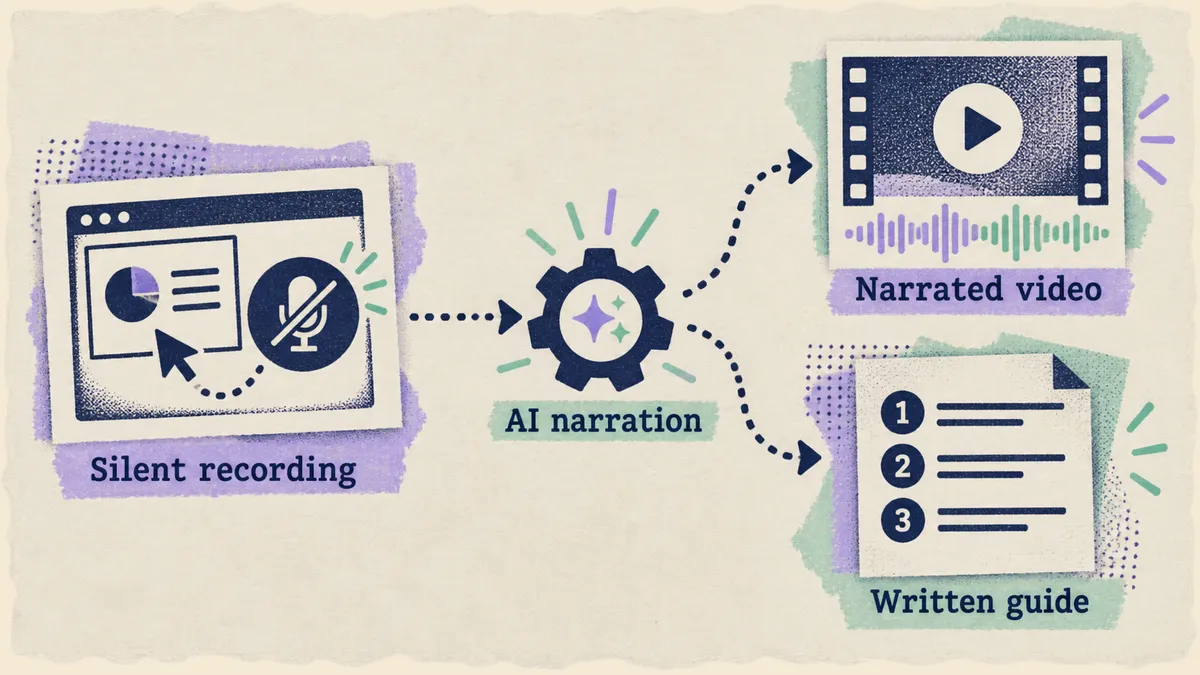
Vorec starts from a silent screen recording of the real product. The AI detects each click, writes narration matched to what happens on screen, and generates the voiceover, with no microphone involved. Freeze-sync holds the frame when an explanation needs more time than the recording allows. The same recording also produces a written step-by-step article.
Plans start at $9/month with a free trial of 200 credits; trial exports carry a watermark. It does not produce interactive click-through demos, lead capture or A/B testing, which is Storylane's core strength.
Bottom Line
$480 a year on Starter for one creator with unlimited published demos, or $6,000 for Growth with five seats. Nothing sits between them, so the honest question is whether you need HTML demos, A/B testing or the multi-team features — not whether you have outgrown Starter's volume, because volume does not move you.
Before you scale down, remember that removing a team member does not lower the bill on its own. And if you are comparing RepX, price it on visitors; it shares a page with Demo Suite and nothing else.
Related: our Storylane vs Navattic comparison and Arcade vs Storylane.
Need a narrated tutorial rather than a click-through demo? Upload one silent screen recording to Vorec and get narration plus a written guide. Start free with 200 credits.