Speechify Pricing 2026: Reader, Studio and API Plans
Vorec Team · 2026-10-01 · About 7 min read
Speechify is three different products with three different price lists, and each has a free plan. Paid entry is Reader Premium at $29 a month or $139 a year; Studio (voiceover production) from $100 a year, sold in credits; and the developer API from $10 a month, metered in characters. A subscription to one does not include the others.
Everything below comes from Speechify's public pricing pages — the Reader, Studio and developer API — read in a rendered, signed-out browser on 1 October 2026, with the Reader's monthly and yearly views both selected. The pages displayed dollar prices. Reader and API structured data identify USD; Studio's repeated Reader schema does not establish its currency. Tax treatment is not stated. Prices change; check before you buy.
The Short Version
| Product | Free | Paid entry | Unit |
|---|---|---|---|
| Reader | 10 robotic voices, 1.5x speed, text-to-speech only | $29/month or $139/year | Listening plan; no usage quota shown |
| Studio | $0, 600 credits | $100/year (Starter), $300/year (Creator) | Studio credits, shared across voiceover, dubbing and avatar |
| API | $0, 500,000 characters/month | $10/month (Starter) | Characters of spoken text |
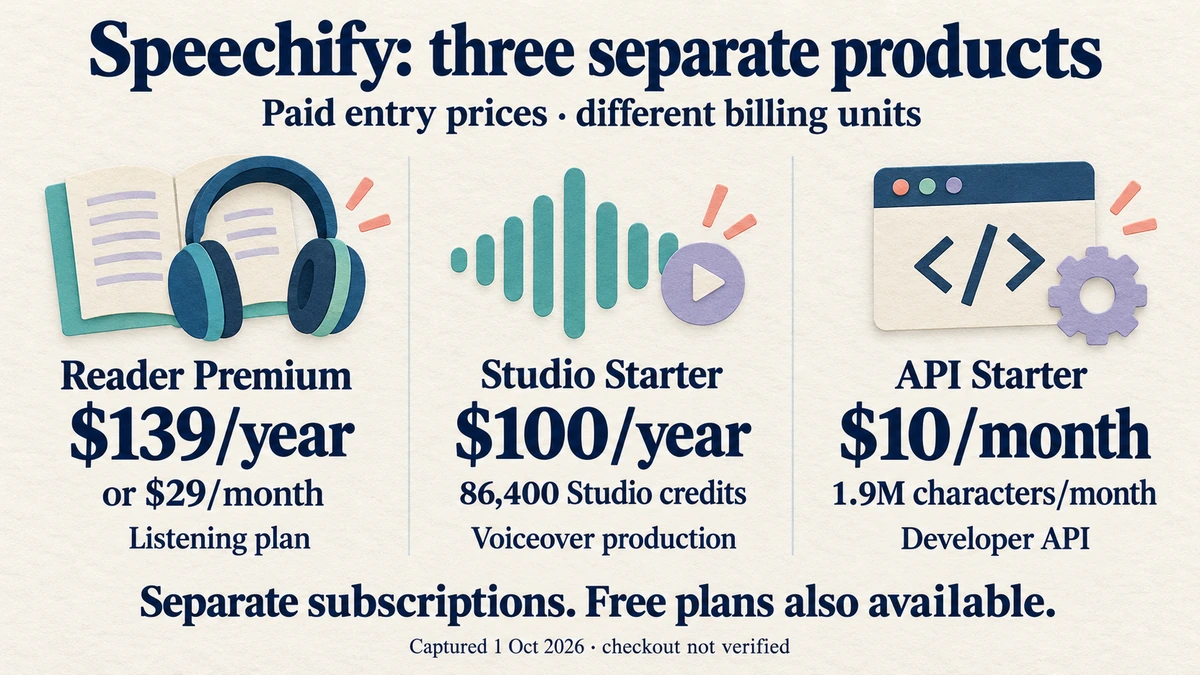
Don't add the allowances together. Studio's FAQ separates its subscription from the Reader, and the API page says a Reader subscription does not include API usage.
Reader Pricing
| Plan | Monthly view | Yearly view | What the page lists |
|---|---|---|---|
| Free | Free | Free | 10 robotic voices, up to 1.5x listening speed, text-to-speech only |
| Premium | $29/month | $139/year | 1,000+ voices, 60+ languages, up to 5x speed, scanning, AI summaries and chats, Drive, Dropbox and OneDrive integration, voice typing, AI podcasts and a voice assistant |
The yearly view advertises a 60% saving. Our arithmetic: 12 × $29 = $348, so $139 saves $209 (about 60%) and works out to roughly $11.58 a month if you commit for the year. That is not a month-to-month price. The yearly card itself reads $139 a year, even though nearby helper text talks about monthly pricing; price against the card.
The pricing page does not state a usage quota, an export entitlement, a commercial-use licence, a cloning feature or a trial length for the Reader, so don't treat paid listening as a voiceover production licence. We saw no student discount or promotion end date on the page.
Studio Pricing
Studio has no monthly or annual switch on its page. The paid cards show annual prices.
| Plan | Price shown | Credits on the card | Gates |
|---|---|---|---|
| Free | $0 | 600 credits | 1,000+ voices, voiceover, dubbing and voice changer; no cloning and no commercial rights |
| Starter | $100/year | 86,400 credits | Cloning, stock music, video, images and sound effects; commercial rights |
| Creator | $300/year | 345,600 credits | Everything in Starter, with four times the credits |
| Enterprise | Through sales | Not stated | No public price |
The page does not say whether credits are delivered up front or reset monthly, so read them as "the allowance listed on the annual plan", not a monthly top-up.
What a credit buys
Credits are one shared balance spent on alternatives, not three separate allowances. The FAQ lists these costs:
| Feature | Cost | Starter (86,400) | Creator (345,600) |
|---|---|---|---|
| Voiceover | 1 credit per second | 24 hours | 96 hours |
| Dubbing | 3 credits per second | 8 hours | 32 hours |
| Avatar | 30 credits per second | 48 minutes | 3 hours 12 minutes |
The paid-plan tooltips on the page show those same equivalents. Our arithmetic for Free: 600 credits is 10 minutes of voiceover, 3 minutes 20 seconds of dubbing, or 20 seconds of avatar if spent entirely on one feature. The page does not confirm a Free export or avatar entitlement.
New generations cost credits, including a new script in the same voice. Pitch, speed and emotion changes regenerate the audio and cost credits; volume-only changes and re-exporting unchanged audio do not.
Free Studio excludes commercial rights, and MP3 downloads point to a paid plan. The FAQ also describes perpetual commercial rights for audio you produce, but the Free card explicitly lists no commercial rights. Treat that FAQ as applying to paid plans.
Studio's cards claim 1,000+ voices. One FAQ describes translating English into 20 other languages, while the Reader claims 60+; the two are different products, so don't carry one count to the other. AI video and sound-effect generation are marked "coming soon".
API Pricing
Self-serve API plans are monthly only, with no annual option, and are metered in characters of spoken text.
| Plan | Monthly fee | Included each month | After the allowance |
|---|---|---|---|
| Free | $0 | 500,000 characters | Pauses until next month; no top-ups |
| Starter | $10 | 1.9 million characters | $10 per million, from prepaid top-up |
| Pro | $99 | 13.5 million characters | $8 per million, from prepaid top-up |
| Scale | $499 | 78 million characters | $6 per million, from prepaid top-up |
| Enterprise | Custom | Committed volume | Contract pricing |
The balance is held in dollars. Included monthly usage expires at the end of the period; prepaid top-ups do not expire. Auto top-up is off until you enable it, and requests pause when both balances are empty. SSML tags and leading or trailing whitespace are not counted; spaces between words are.
Upgrades take effect immediately, charge the new monthly fee at once and reset the billing date; downgrades and cancellations take effect after the current paid month, and cancelling reverts you to Free. Free includes commercial use, which is the opposite of Free Studio. Paid plans advertise voice cloning (Pro says there is no per-plan limit), Starter includes up to 3 seats, and only Scale adds batch synthesis, up to 25 seats and 100 service accounts. Self-serve covers English on one model or six languages on another; wider coverage goes through sales.
Enterprise voice agents are a separate quoted contract with no published per-minute rate.
What The Pages Do Not Establish
- Studio credit reset, rollover, expiry and top-up pricing, and whether Studio is billed per seat.
- Reader usage caps, commercial licence terms and trial length.
- Cloning consent procedures and exact limits outside Pro's no-per-plan-limit claim.
- Refunds, taxes and full licensing terms for any product.
- Enterprise prices across all three.
Is Speechify Worth It?
Reader Premium: yes, if you want to listen to documents and web pages. At $139 a year it is built for listening, not for producing voiceover you publish.
Studio: Starter's listed allowance equals up to 24 hours of voiceover generation if spent entirely on voiceover. Regenerations use the same balance, so this is not a promise of 24 hours of finished audio. Dubbing costs three times as many credits per second and avatar thirty times.
API: start on Free if you are prototyping, since 500,000 characters a month and commercial use cost nothing.
How It Compares
| Entry paid price (billing basis shown) | What you get | |
|---|---|---|
| Speechify | Reader $139/yr; Studio $100/yr; API $10/mo | Listening, voiceover credits, developer API |
| ElevenLabs | See our ElevenLabs pricing breakdown | Voice generation, credits-based |
| HeyGen | See our HeyGen pricing breakdown | Avatar video, credits-based |
| Vorec | $86/yr ($7.17/mo equivalent) | Screen recording narrated from what happens on screen |
These products have different units, so the table is orientation rather than like-for-like.
Where Vorec Fits
Speechify focuses on text-to-speech, from listening to voiceover production and an API; Vorec focuses on narrated screen tutorials and written guides. If you need a voice for a script, evaluate Speechify.
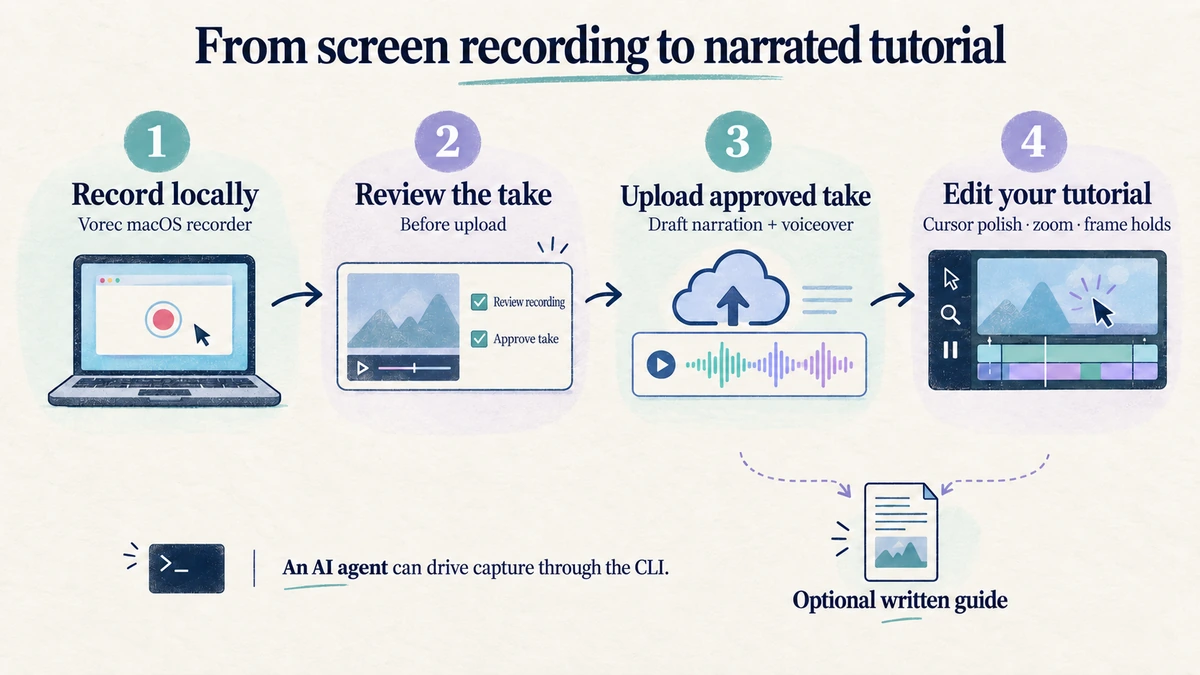
Where they meet is the tutorial voiceover. If the thing you are making is a walkthrough of an app, the narration comes from what happens on screen. Vorec records your screen through its macOS recorder, and an AI agent can drive that capture through the CLI, recording locally so you review the take before anything is uploaded. It then uses captured action data, or analyses a recording you upload, to draft narration matched to the workflow and generate the voiceover, so no microphone narration is required. In the editor you can add smooth cursor motion, cursor-follow zoom and click-based auto-zoom, and freeze-sync can hold a frame to give an explanation time to finish. The same capture can also produce a written step-by-step guide, and narration regenerates in supported languages on eligible plans without re-recording.
Plans start at $9/month, with a 7-day free trial of 100 credits, no credit card required, whose exports carry a watermark.
Bottom Line
Speechify's paid entry prices are $139 a year for Reader Premium (or $29 month-to-month), $100 a year for Studio Starter and $10 a month for API Starter, each in its own unit.
Three details to check before you buy: Studio's credit reset period is not stated, Free Studio has no commercial rights and points MP3 downloads to a paid plan, and the Reader's $11.58 a month figure only applies on the annual commitment.
Related: our ElevenLabs pricing breakdown covers another credits-based voice product.
Want the recording to narrate itself? Record with Vorec, or upload one you already have, and get a narrated tutorial plus a written guide. Start free.