OpenAI x Ironclad: Computer-Use Agents on Real Software (2026)
Vorec Team · 2026-10-26 · About 7 min read
On 6 October 2026 OpenAI published a research collaboration with Ironclad, a contracting software company. OpenAI trained GPT-6 Astra on synthetic contracting tasks in hosted Ironclad environments, and evaluated it against GPT-5.6 Sol on 11 research tasks inside Ironclad's product. GPT-6 Astra averaged 55.0% on OpenAI's task rubrics, against 41.6% for GPT-5.6 Sol, with estimated time per attempt falling from 37.0 to 19.2 minutes. OpenAI says the results cover only those 11 research tasks, and that the times are simulated estimates, not measured customer time savings.
This page sums up OpenAI's post, Advancing computer use with Ironclad, checked on 26 October 2026. It's a research write-up by OpenAI about its own models, not an independent evaluation, and we haven't run the tasks. Where something is our reading rather than OpenAI's statement, we say so.
The study at a glance
| Question | What OpenAI says |
|---|---|
| Published | 6 October 2026 |
| Partner | Ironclad, contracting software |
| Tasks | 11, across legal, commercial and procurement work |
| Who chose them | Ironclad employees and people who use Ironclad at OpenAI, with OpenAI researchers |
| Human effort per task | Estimated 30 to 40 minutes for an experienced user, on average |
| How tasks were scored | 8 to 50 criteria per task, depending on complexity |
| Training method | Synthetic training tasks in hosted Ironclad environments, with reinforcement learning |
| Training data | Simulated tasks built from public contracts in the SEC's EDGAR database; no OpenAI customer data and no nonpublic Ironclad customer data |
| Models compared | GPT-6 Astra (Max reasoning) and GPT-5.6 Sol (High reasoning) |
What the agents had to do
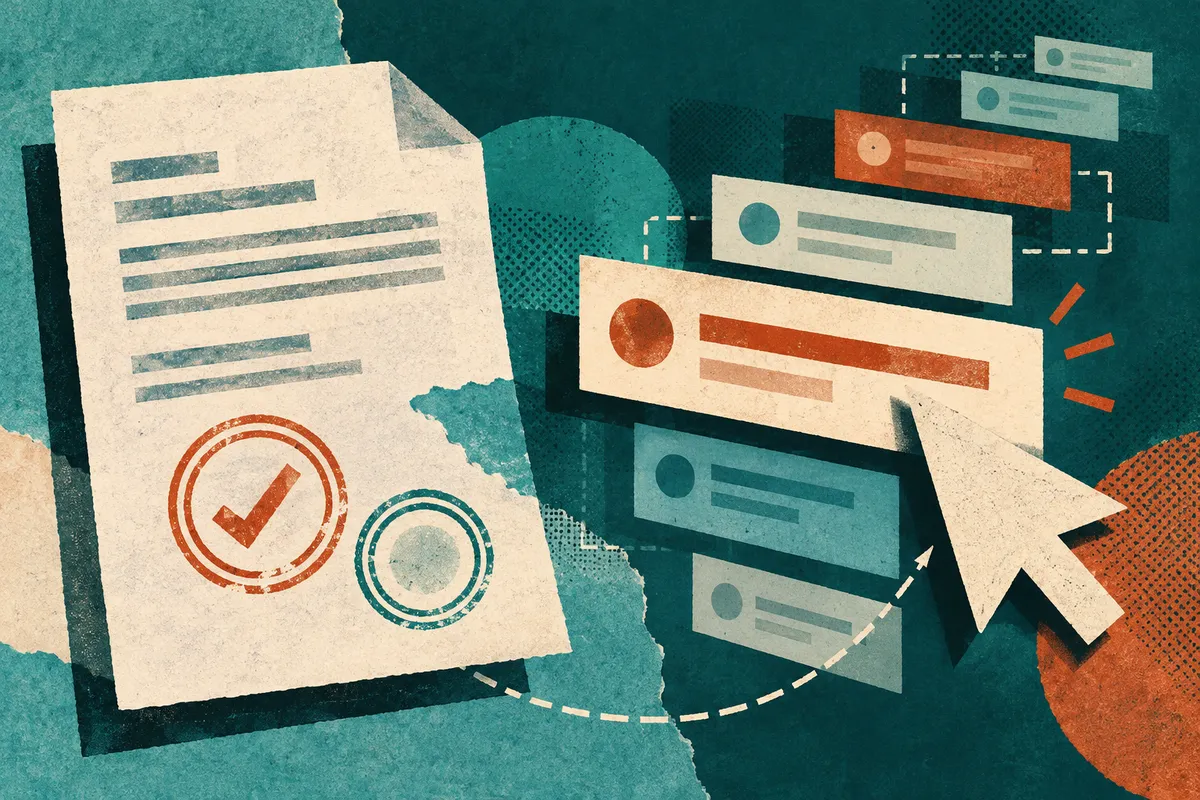
The tasks were configuration work inside the software, not drafting text. OpenAI's examples include setting up nondisclosure agreements, building procurement approval processes, and updating a reusable legal clause so it reflects the jurisdiction a requester selects.
OpenAI walks through one case: a legal operations team setting up a process for buying software. Finance approves purchases above a threshold, Security reviews certain requests, and Legal reviews nonstandard terms. The agent has to turn those rules into an intake form, templates, approval rules and a record of the final agreement, then check that requests above and below the threshold take the right path.
OpenAI's point is that getting each click right isn't enough: the finished process has to hold up in every case it was built for.
The results, and how to read them
| Metric | GPT-5.6 Sol (High reasoning) | GPT-6 Astra (Max reasoning) |
|---|---|---|
| Mean rubric score, 11 tasks | 41.6% | 55.0% |
| Estimated average time per attempt | 37.0 minutes | 19.2 minutes |
OpenAI adds that an internal model used in developing Astra scored 63.7% on the same tasks. In the two demonstration clips, on one task, Astra met about 94% of the criteria in an estimated 20 minutes and Sol about 85% in an estimated 32 minutes.
Some arithmetic you can check from the table. The score rose by 13.4 percentage points (55.0 − 41.6). Relative to Sol, that's about 32% higher (13.4 ÷ 41.6 ≈ 0.32), which matches OpenAI's "32% higher" statement. Estimated time fell by 17.8 minutes (37.0 − 19.2), about 48% (17.8 ÷ 37.0 ≈ 0.48), matching OpenAI's "48% lower".
Three limits OpenAI states itself:
- Eleven tasks, one product. The footnote says the results cover the 11 research tasks, "not all Ironclad workflows".
- Simulated time. The times are estimates derived from assumed model speeds, not measured customer time savings.
- Each model at its best setting. Astra ran with Max reasoning and Sol with High, the settings where each scored highest. So this compares best configurations, not identical ones.
And one we'd add as our reading: a mean score of 55.0% means that, on average, the stronger model in the comparison met about half of the scored criteria. OpenAI frames this as progress, and says human oversight still matters on these tasks. That's a long way from handing over contract setup unattended.
What it suggests for teams who document workflows
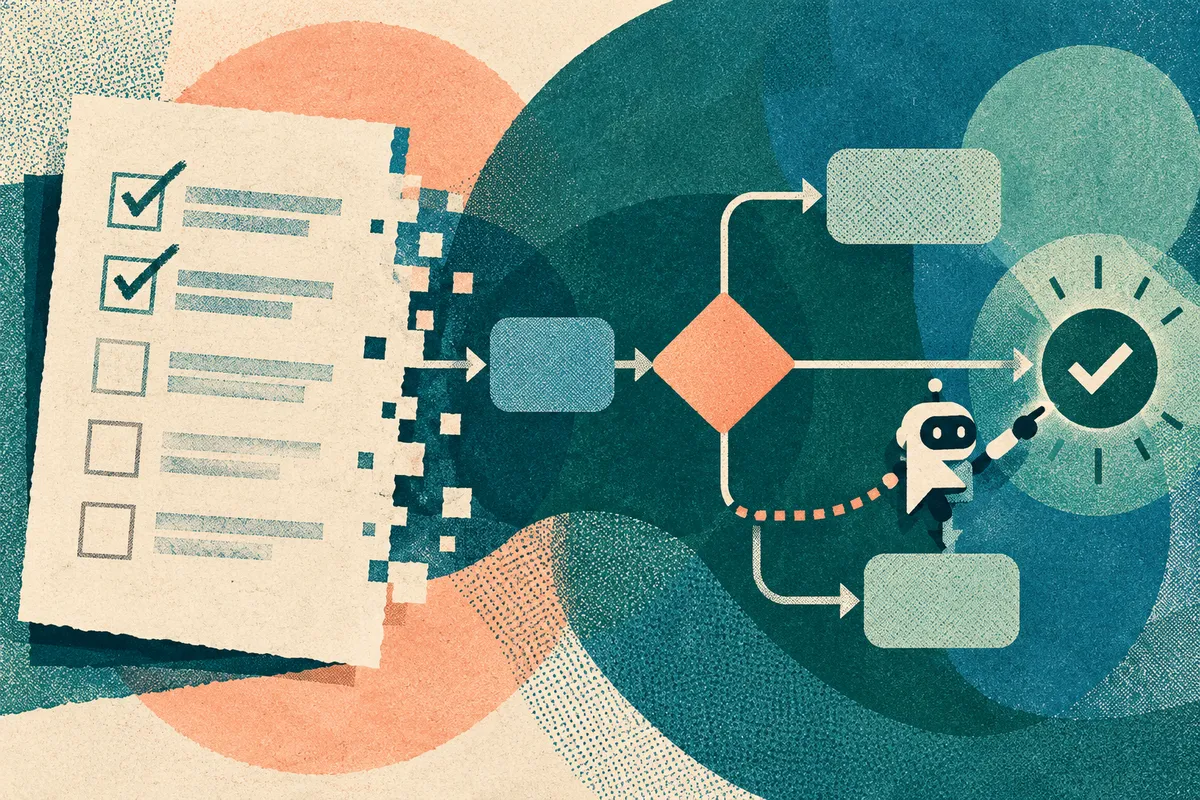
The study isn't about tutorials, but its method looks familiar to anyone who writes SOPs or training material. This section is our reading, not OpenAI's.
The tasks started from people who know the work. OpenAI says Ironclad's expertise defined "what success looks like". That's the same input a good SOP or onboarding guide needs: the business rules, the exceptions and how you know the result is right.
Success was a list of checkable criteria. Each task had 8 to 50 criteria. A written step-by-step guide with an expected result after each step is close to that shape, and it's useful whether a person or an agent follows it.
Agents have to keep every rule in view for the whole task. OpenAI's post says that if an agent loses track of a rule halfway through, that limits what a company can confidently ask it to do. The post doesn't report how often that happened. Long procedures are hard for people to hold in mind too, which is one reason procedure docs break work into steps.
OpenAI showed the result as screen recordings. The comparison is presented as two clips of the agents working in Ironclad. As agents do more screen work, recordings of that work become a way to review and explain it.
OpenAI is also inviting a small number of software companies to propose tasks today's agents "still can't reliably complete", with evidence of where the agent fails and how success would be judged. If your product has workflows like that, clear documentation of the correct path is part of what such a proposal needs.
Where Vorec fits
Vorec turns a recorded workflow into a narrated tutorial and, if you want one, a written step-by-step guide. It records your screen with its own macOS app, and an AI agent can drive that recorder through the Claude Code plugin, capturing locally for you to review before anything is uploaded. It then drafts narration matched to the workflow it captured and generates the voiceover, so nothing is spoken into a microphone. In the editor you can add smooth cursor motion, cursor-follow zoom and click-based auto-zoom, and freeze-sync can hold a frame to give an explanation time to finish. The written guide comes with annotatable screenshots, and narration regenerates in supported languages on eligible plans. You can upload an existing recording instead if you already have one.
Vorec doesn't train or evaluate agents. Its part is the documentation: showing and explaining the correct path through a piece of software, for people and for the teams reviewing agent work.
The free trial needs no card (current allowances on the pricing page); trial exports are watermarked. Paid plans are Starter at $9 a month, Pro at $24 and Business at $59, or $86, $230 and $566 a year.
Frequently asked questions
What is the OpenAI and Ironclad collaboration?
A research partnership announced by OpenAI on 6 October 2026. OpenAI and Ironclad defined 11 contracting research tasks inside Ironclad's software, used to evaluate the models. Separately, OpenAI built synthetic training tasks around representative workflows and trained with reinforcement learning in hosted Ironclad environments.
How did GPT-6 Astra perform on the Ironclad tasks?
It averaged 55.0% on OpenAI's task rubrics, against 41.6% for GPT-5.6 Sol, with estimated time per attempt of 19.2 minutes against 37.0. OpenAI says the times are simulated estimates.
Was customer data used to train the models?
OpenAI says the simulated training tasks were built from contracts publicly available in the SEC's EDGAR database, after filtering for personal information, and that it didn't use OpenAI customer data, OpenAI's internal contracts, or nonpublic Ironclad customer data or contracts.
Do these results apply to all contracting work?
No. OpenAI says the results cover the 11 research tasks, not all Ironclad workflows.
Can companies take part?
OpenAI says it's inviting a small number of software companies to propose tasks today's agents can't reliably complete, with evidence of failures, people who know the work, a secure test environment and data that can be used for research.
Related reading: Computer Use Agents: What the Vendor Docs Say, OpenAI Agents API Computer Use, AI Agents That Submit Forms: Anthropic's Oct 2026 Report and Use Any Coding Agent to Record Your App Demo.
Want the recording to narrate itself? Record with Vorec, or upload one you already have, and get a narrated tutorial plus a written guide. Start free. Trial includes up to 3 projects; exports carry a watermark.