GPT-6.1 Terra Computer Use: Prices, Scores, Limits (2026)
Vorec Team · 2026-11-06 · About 9 min read
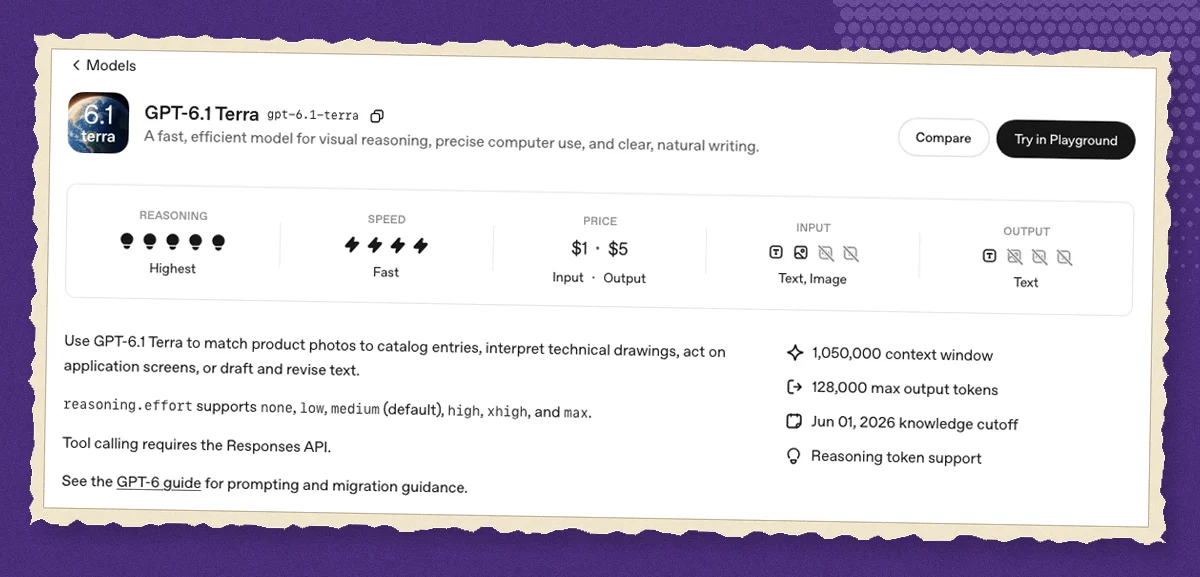
GPT-6.1 Terra is the OpenAI model announced on 26 October 2026 for "fast and capable computer use at scale": a fast, efficient model that combines visual reasoning with computer use, priced at $1 per million input tokens and $5 per million output tokens, available in ChatGPT Work, Codex and the API as `gpt-6.1-terra`. OpenAI's announcement positions it for the computer-based tasks that fill a workday, filling out forms, reading invoices into accounting software, editing videos, and reports benchmark gains over GPT-5.6 Terra at a lower price. For teams that make tutorials the relevant question is what happens once an agent can do those tasks: in our view, teams may still need to show the work to the people who check it, learn it or take it over.
Checked on 6 November 2026 against two primary sources: OpenAI's announcement page "Introducing GPT-6.1 Terra" (published 26 October 2026 per OpenAI's news feed) and the model's page in OpenAI's API documentation. Every benchmark number below is OpenAI's own report; we have not reproduced any of them, and the announcement links a system card for the detail.
What OpenAI announced
The announcement describes GPT-6.1 Terra as a step up from GPT-5.6 Terra that "excels at the communication and computer-based tasks that fill the workday", and places it on what OpenAI calls the cost-intelligence frontier: a new balance of speed, capability and cost inside the GPT-6 family rather than the most capable model in it. The page is explicit that GPT-6.1 Sol and GPT-6 Astra remain the better choice for the most complex coding tasks.
| What the announcement says | |
|---|---|
| Announced | 26 October 2026 |
| Positioning | Fast and capable computer use at scale; visual reasoning plus clearer writing |
| Compared against | GPT-5.6 Terra (predecessor), GPT-6.1 Sol, GPT-6 Astra, Claude Opus 5.5 |
| Where it runs | ChatGPT Work and Codex for Plus, Pro, Enterprise and Edu users; the OpenAI API as `gpt-6.1-terra` |
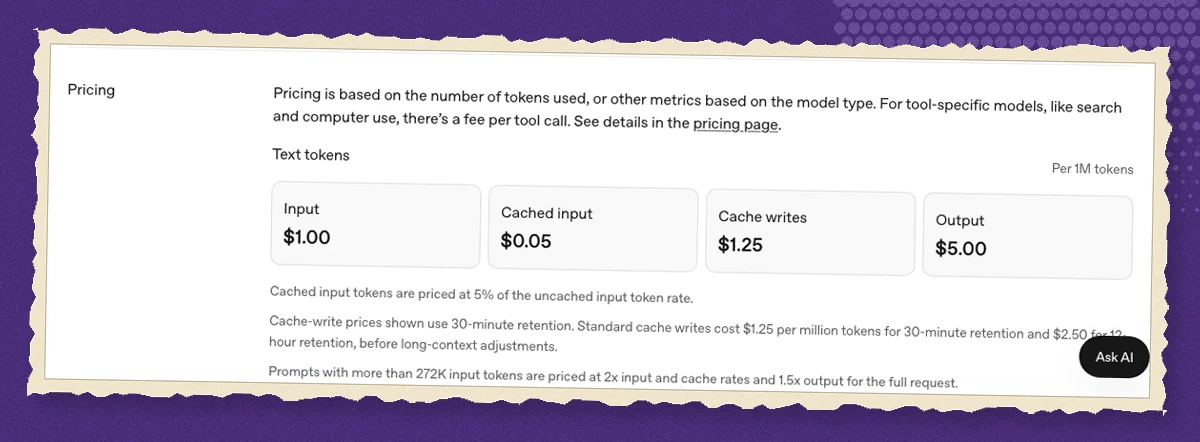
| Standard API price | $1 per million input tokens, $0.05 per million cached input tokens, $5 per million output tokens |
| Price claim | Standard API prices 50% lower than GPT-5.6 Terra and GPT-6.1 Sol |
| Safety | Meets the Critical threshold in cybersecurity under OpenAI's Preparedness Framework; keeps the protections developed for GPT-6 Astra |
The API documentation's model page adds the operating limits the announcement leaves out: a 1,050,000-token context window, 922,000 maximum input tokens, 128,000 maximum output tokens, a knowledge cutoff of 1 June 2026, text and image input with text output (audio and video are listed as unsupported), and `reasoning.effort` settings from `none` to `max` with `medium` as the default. Computer use, web search and file search are listed among the tools, and tool calling requires the Responses API. Cache writes are $1.25 per million tokens with 30-minute retention, and Batch and Flex processing are listed at 50% below Standard.
Three lines on the same page keep the headline price from being a task price. For tool-specific models, like search and computer use, the page says there is a fee per tool call, and refers to the pricing page for the details. Prompts with more than 272,000 input tokens are priced at twice the input and cache rates and 1.5 times the output rate for the whole request. And the $1.25 cache-write rate applies to 30-minute retention; 12-hour retention is listed at $2.50. A computer-use task that takes many screenshots and tool calls is therefore priced by its calls and its context as much as by the per-token rate.
The computer-use claims, as OpenAI reports them
The announcement gives two computer-use benchmark comparisons and a speed claim. The numbers are OpenAI's, at the reasoning settings it chose:
- Agents' Last Exam, described as professional tasks such as turning architectural drawings into a 3D model or logging an animated film shot by shot. At medium reasoning effort, OpenAI reports GPT-6.1 Terra 15 percentage points above GPT-5.6 Terra at about one-third the cost, and on par with GPT-6 Astra at one-tenth its price per token. At max effort it reports Terra as over three times as token-efficient as Claude Opus 5.5, at one-fourth the price per token, which OpenAI combines into a roughly 9x lower cost per task.
- OSWorld 2.1, which tests desktop-app use over multi-step tasks. At medium effort, OpenAI reports Terra above GPT-5.6 Terra's best score at a fraction of the cost per task; the page gives the comparison, not the raw score.
- Speed. OpenAI reports Terra completing tasks over three times faster than both GPT-6 Astra and GPT-6.1 Sol.
Two things to keep in mind when reading those. First, "cost per task" combines price per token with how many tokens a model spends. OpenAI presents the roughly 9x as the result of those two factors, but the page doesn't show the arithmetic, so treat the 9x as OpenAI's summary figure rather than something you can rebuild from the other two. Second, the comparison with Claude Opus 5.5 is OpenAI's own evaluation of a competitor's model at settings OpenAI chose, and the announcement doesn't publish the harness. Treat it as a vendor claim until an independent run exists.
Visual reasoning, factuality and coding
The same page reports three other results, which matter for computer use because an agent that misreads a screen or invents a value fails the task:
- MMMU-Pro (visual reasoning): Terra above GPT-5.6 Terra at every reasoning setting, and close to GPT-6 Astra and GPT-6.1 Sol at lower cost.
- Factual errors, on OpenAI's internal benchmark of error-inducing prompts: the error rate at low reasoning effort fell from 53.6% with GPT-5.6 Terra to 16.7% with GPT-6.1 Terra, and at maximum effort fell 18 percentage points to 4.3%. This is an internal benchmark; the prompts aren't published on the page.
- Terminal-Bench 4.0 (command-line coding): 50.3% of tasks solved at maximum effort, against the 21.5% the page calls GPT-5.6 Terra's published score. Terminal-Bench-Science 0.1: above GPT-6.1 Sol at lower cost, within five points of Opus 5.5 at less than one-fifth the estimated cost, again per OpenAI.
On alignment, the announcement says Terra is more likely than GPT-5.6 Terra to stay within scope and disclose limitations and blockers, and that it showed strong resistance in OpenAI's prompt-injection tests. Those are OpenAI's evaluations of its own model; the page points to the system card for the method.
What this means for tutorials and documentation
This is our reading, not OpenAI's. The announcement's examples are the tasks that training videos and SOPs exist to teach: entering invoice details into accounting software, filling out forms, editing videos. If an agent does the task, three needs look to us to become more important than they were when a person did it:
- Someone has to check the work. An agent that stays in scope and discloses blockers, as OpenAI claims, still produces a result a reviewer can sign off on. A recording of the agent's session is one way to keep an audit trail, and a narrated version of it is the handover.
- People still learn the task. Some teams won't hand a workflow to an agent entirely; the person who covers for it, or who handles the exceptions, learns from a recording of the standard path.
- The material can serve both. OpenAI's examples are visual, and so are tutorials. In our reading a recorded, narrated walkthrough of a workflow can brief the next hire, and the same material can be given to an agent as context; how much an agent gets from it is not something the announcement measures.
Our earlier pieces on computer-use agents, OpenAI's Agents API computer use and OpenAI's work with Ironclad cover how these agents see and click a screen; what an AI agent can record covers the recording side.
Where Vorec fits
Vorec records your screen with its own macOS recorder, and an AI agent can drive it for you through the Claude Code plugin, capturing locally for you to review before anything is uploaded. It then drafts narration matched to the workflow it captured and generates the voiceover, so nothing is spoken into a microphone. In the editor you can add smooth cursor motion, cursor-follow zoom and click-based auto-zoom, and freeze-sync can hold a frame to give an explanation time to finish. The same capture can also produce a written step-by-step guide, with annotatable screenshots, and narration regenerates in supported languages on eligible plans, without re-recording. You can upload an existing recording instead if you already have one.
Vorec has a free trial, no credit card required (current allowances on the pricing page), then $9, $24 or $59 a month ($86, $230 or $566 a year). Read live from our plan catalogue on 6 November 2026.
Frequently asked questions
What is GPT-6.1 Terra?
OpenAI's model announced on 26 October 2026 for fast, efficient computer use and visual reasoning. OpenAI recommends GPT-6.1 Sol and GPT-6 Astra for the most complex coding tasks and describes Terra as faster than both, cheaper per token, and a significant step up from GPT-5.6 Terra.
How much does GPT-6.1 Terra cost in the API?
Standard pricing is $1 per million input tokens, $0.05 per million cached input tokens and $5 per million output tokens, which OpenAI says is 50% below GPT-5.6 Terra and GPT-6.1 Sol. Read on 6 November 2026.
Where is GPT-6.1 Terra available?
In ChatGPT Work and Codex for Plus, Pro, Enterprise and Edu users, and in the OpenAI API under the model id `gpt-6.1-terra`, per the announcement.
Is GPT-6.1 Terra better than Claude Opus 5.5 at computer use?
OpenAI reports Terra as over three times as token-efficient as Claude Opus 5.5 on Agents' Last Exam at max effort and at one-fourth the price per token. That is OpenAI's evaluation of a competitor's model at settings OpenAI chose, and it is a statement about token efficiency and price, not about which model scores higher; the page's charts are images we could not read as text, so we don't report scores from them. We have seen no independent run and make no claim either way.
Does GPT-6.1 Terra record what it does?
The announcement doesn't describe session recording. Recording an agent's work is a separate step, and we cover the options in what an AI agent can record.
Want the recording to narrate itself? Record with Vorec, or upload one you already have, and get a narrated tutorial plus a written guide. Start your free trial, no credit card required (current allowances on the pricing page).