Voxtral 3 Text-to-Speech: Tags, Cloning, Limits (2026)
Vorec Team · 2026-11-02 · About 10 min read
On 20 October 2026, Mistral released Voxtral 3, a family of speech-to-text and text-to-speech models plus a voice agent SDK. The text-to-speech model, Voxtral TTS 3 (`voxtral-mini-tts-3-0`), is in public preview at $13 per million characters. Mistral's docs list 35 languages with 50+ dialects, 34 inline emotion tags, zero-shot voice cloning from a short clip, professional cloning from 30 minutes to 3 hours of audio, phoneme-level pronunciation hints, and mp3, wav, pcm, flac and opus output. Style instructions are listed as not available at launch.
This page summarises Mistral's Voxtral 3 announcement and its audio documentation, read on 27 October 2026. We haven't run the model ourselves, and every benchmark below is Mistral's own. Where something is our reading rather than Mistral's statement, we say so. The model is in public preview, so details may change.
Voxtral TTS 3 at a glance
| Question | What Mistral's docs say |
|---|---|
| Released | 20 October 2026, public preview (model page) |
| Model IDs | `voxtral-mini-tts-3-0` (offline, with streaming); `voxtral-mini-tts-realtime-3-0` (realtime) |
| Price | $13 per 1M characters |
| Languages | 35 languages, 50+ regional dialects |
| Preset voices | 22 locale entries (21 distinct language names) in the docs' preset table; English has the most (6 UK, 4 US) |
| Emotion control | 34 emotion values, written inline as `[emotion=calm]` |
| Pace control | Inline `[pace=...]` tags; the docs disagree on how many values exist (see below) |
| Cloning | Zero-shot from a short MP3 or WAV clip; professional cloning from 30 minutes to 3 hours |
| Pronunciation | Phoneme hints from a closed list of 50 phonemes |
| Output formats | mp3, wav, pcm, flac, opus |
| Not at launch | Style instructions (describing the whole delivery in plain words) |
| Where it runs | Mistral API (European, US and global endpoints) or self-deployment |
How Voxtral 3 directs a voice
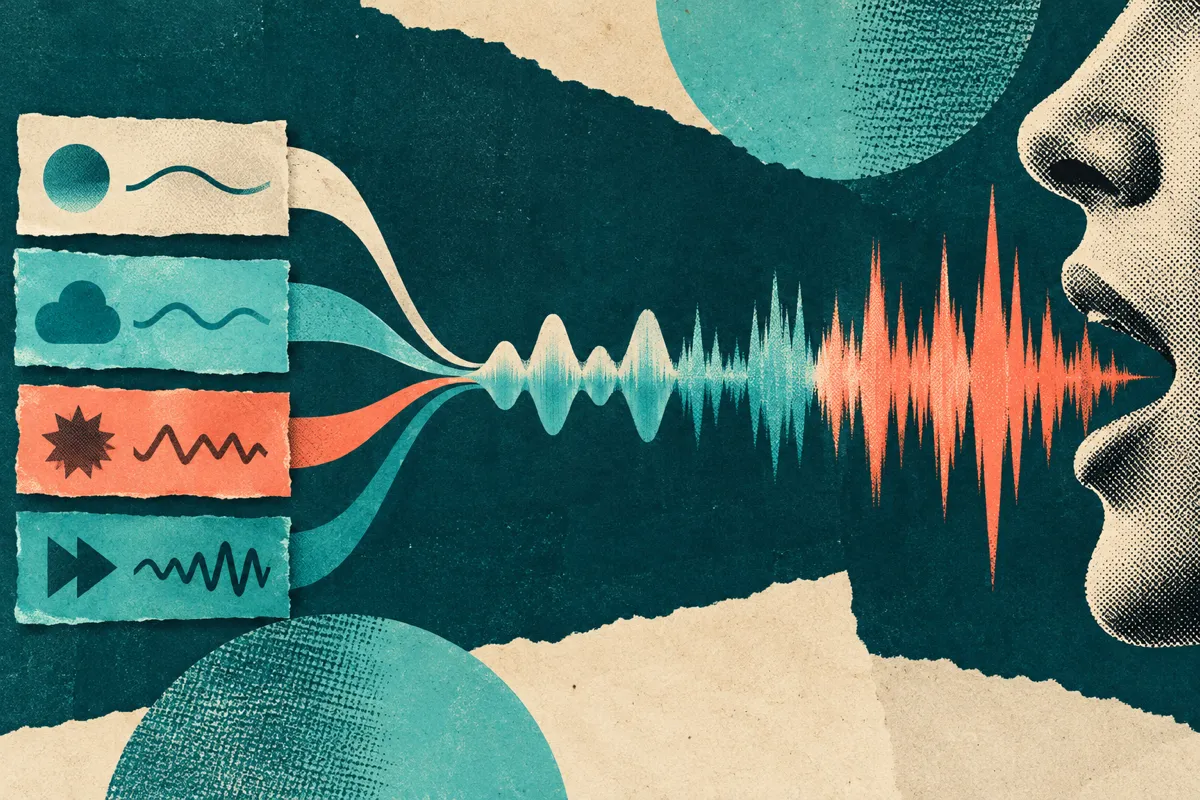
Voxtral 2 handled emotion by giving each preset speaker one variant per mood. The migration guide uses `gb_jane_sad` as its example. Voxtral 3 moves emotion into the text itself. According to the emotion and pace tags page:
- You write a tag in square brackets before the words it should affect, such as `[emotion=calm]` or `[pace=slow]`.
- The tag isn't spoken, and it applies until the next tag or the end of the input.
- You can stack one emotion tag and one pace tag, such as `[emotion=calm][pace=slow]`, but not two of the same type on the same stretch of text.
- An unsupported value, such as `[emotion=ecstatic]`, isn't rejected. The request succeeds and the tag is silently ignored.
- Disfluency tags add sounds such as `[breath]`, `[um]` or `[laugh]`.
The 34 emotions run from amused, calm and confident to urgent, warm and wistful. Old Voxtral 2 preset IDs are still accepted, so existing integrations keep working.
One limit matters for multilingual work. Mistral says emotion, pace and disfluency tags work in English, and are "untested but expected to work" in French, German, Spanish, Italian, Portuguese and Hindi. For the other supported languages, the docs make no claim either way.
Expressiveness and pronunciation
Two more controls are documented. Expressiveness is a number of 1.0 or higher; the docs say higher values trade voice similarity for stronger delivery, and the default is set by the service. Custom pronunciation takes phoneme hints from a closed list of 50 phonemes, for names and terms the model would otherwise misread. Mistral's announcement demonstrates this with invented product and assistant names.
Voice cloning: two different things

Mistral documents two kinds of cloning on its voice cloning page, and they need very different amounts of audio.
| Zero-shot cloning | Professional cloning (Pro Voice) | |
|---|---|---|
| Audio needed | A short recording; the limits page says a few seconds to a few minutes | 30 minutes to 3 hours of clean, single-speaker audio, per Mistral's recommendation |
| Training | None | Not described as zero-shot; Mistral calls it an adaptation of the speaker's character and range |
| How you use it | Send the clip with one request, or save it as a voice and reuse its ID | Not detailed on the cloning page beyond the recording advice |
| Saved voice retention | 30 days by default, settable from 1 to 365 days via the API | Not stated |
Mistral's recording advice for professional cloning is practical: record in a quiet room with the same microphone and setup throughout, speak in the style you want reproduced, and include a range of emotions, because a single flat tone can make the clone sound robotic. The docs add that consistency matters more than length.
A cloned voice isn't tied to the language of its recording. For languages that have no preset voice, Mistral suggests cloning from a recording in the target language.
When the announcement mentions "voice cloning from 30+ minutes of sampled audio", that figure describes the professional tier. The everyday zero-shot clone, per the docs, works from a much shorter clip.
Where Mistral's own docs disagree
We read the announcement and the linked documentation pages on the same day. Three details don't line up, and we report them as found rather than picking a side:
- Pace tags. The model page says "2 pace tags", and the limits page lists "slow or fast". The emotion and pace tags page shows a five-row table: very-slow, slow, moderate, fast and very-fast.
- Preset-voice languages. The announcement says voice presets are available in 18 languages. The languages page lists preset voices in 22 locale entries, which is 21 distinct language names because UK and US English have separate rows. That list includes Japanese, Polish, Turkish and Ukrainian, none of which appear in the announcement's 18.
- Cloning audio. As above, "30+ minutes" in the announcement refers to Pro Voice. The zero-shot clip on the limits page is a few seconds to a few minutes.
Our reading: the docs and the announcement were probably written at different stages of the preview. If you build on a specific value, test it, because the API doesn't return an error for a tag value it doesn't recognise.
Price, and what the benchmarks do and don't show
Voxtral TTS 3 costs $13 per million characters on the model page. In smaller units:
| Text length | Arithmetic | Cost |
|---|---|---|
| 1,000 characters | 1,000 ÷ 1,000,000 × $13 | $0.013 |
| 10,000 characters | 10,000 ÷ 1,000,000 × $13 | $0.13 |
| 100,000 characters | 100,000 ÷ 1,000,000 × $13 | $1.30 |
The announcement says this costs less to run than comparable models from OpenAI TTS-1, Deepgram, ElevenLabs Flash and Gemini Flash. That's Mistral's comparison, and the other vendors' prices weren't checked for this page.
The announcement also publishes quality-per-dollar charts. Read them with their methods in mind:
- Who ran them. One chart uses Voice Code Bench, from BeSimple AI: 300 English prompts focused on numbers and unique names in customer-support scripts. The pronunciation, multilingual (11 languages, 377 prompts) and expressive-English charts are labelled as internal evaluations.
- How they were judged. Every chart uses an AI model, gemini-3.8-flash, as the judge, not human listeners.
- What they focus on. The tasks lean towards contact-centre speech, not long-form narration.
A vendor's benchmark tells you what the vendor chose to measure. It isn't an independent ranking, and it doesn't cover a ten-minute tutorial voiceover.
What the rest of Voxtral 3 adds
The release isn't only TTS. Per the announcement:
- Transcription. Voxtral Small Transcribe 3 and Mini Transcribe 3 cover 50 languages, with diarization (who spoke when) and context biasing for technical terms. Mini is a 4B-parameter model priced at $0.0035 per minute.
- Realtime transcription. Voxtral Mini Transcribe Realtime 3 targets voice agents with sub-500 ms latency and end-of-turn detection.
- A voice agent SDK built on LiveKit, which chains listening, a reasoning model and speech into one streaming pipeline, over phone (SIP) or browser (WebRTC).
One change matters if you make captions. The migration guide says word-level timestamps are gone from Voxtral 3 transcription: `timestamp_granularities` accepts `segment` only, and `word` returns a 400 error. Segment timestamps still work for subtitles, but anything that highlights captions word by word needs another source of word timing.
What this means for narrating tutorials
Our reading of where Voxtral TTS 3 fits for screen tutorials, demos and training videos:
- Inline tags suit scripted narration. A tutorial script is complete text, which is the offline mode Mistral recommends. Tags let you slow down a warning step or keep an onboarding script warm without switching voices.
- Phoneme hints address a common tutorial problem. Product names, feature names and acronyms are the words TTS voices most often get wrong, and the hint system is designed for exactly those.
- Multilingual output needs checking. The model speaks 35 languages, but emotion and pace tags are only described as working in English. A translated tutorial may come out flatter than the English original, and you should listen to each language before publishing.
- It's an API, not a tutorial tool. Voxtral generates audio from text. Writing a script that matches the clicks on screen, timing each line to the right moment, and editing the video are all still your job, or the job of another tool.
That last point is where Vorec comes in. Vorec isn't built on Voxtral, and it doesn't need you to write a script at all. Vorec has its own macOS recorder, and an AI coding agent can drive it for you through the Claude Code plugin, with the take staying on your Mac until you've reviewed it. Vorec then drafts narration matched to the workflow it captured and generates the voiceover, and freeze-sync can hold a frame so an explanation has time to finish. Narration regenerates in supported languages on eligible plans without re-recording, and you can generate a written step-by-step guide from the same capture. You can also upload a recording you already have.
Vorec starts with a free trial, no credit card required (current allowances are on the pricing page). The trial includes up to 3 projects, and exports carry a watermark. Paid plans are Starter at $9 a month ($86 a year), Pro at $24 a month ($230 a year) and Business at $59 a month ($566 a year). For other speech models, see our pages on Eleven v4 and ElevenLabs alternatives, or our guide to adding an AI voice to a screen recording.
FAQ
What is Voxtral 3?
A family of Mistral speech models released on 20 October 2026: Voxtral Small and Mini Transcribe 3 for speech-to-text, a realtime transcription model, Voxtral TTS 3 for text-to-speech, and a voice agent SDK. Mistral's model page lists Voxtral TTS 3 as a public preview.
How much does Voxtral TTS 3 cost?
$13 per million characters, per Mistral's model page. That works out to $0.013 per 1,000 characters.
How many languages does Voxtral TTS 3 support?
35 languages and 50+ regional dialects, per Mistral's languages page. Preset voices cover fewer languages; for the rest, Mistral suggests cloning a voice from a recording in the target language.
How much audio does Voxtral voice cloning need?
Zero-shot cloning uses a short MP3 or WAV clip, which the limits page puts at a few seconds to a few minutes. Professional cloning, which Mistral calls Pro Voice, needs 30 minutes to 3 hours of clean, single-speaker audio.
Does Voxtral TTS 3 support emotion control?
Yes, through 34 inline emotion tags such as `[emotion=warm]`, plus pace and disfluency tags. Mistral says the tags work in English, and are untested but expected to work in French, German, Spanish, Italian, Portuguese and Hindi.
Can Voxtral 3 transcription give word-level timestamps?
No. Mistral's migration guide says Voxtral 3 transcription returns segment timestamps only, and a request for word timestamps returns a 400 error.
Can I run Voxtral 3 on my own servers?
Mistral says Voxtral 3 is available through its API on European, US and global endpoints, or for self-deployment on your own infrastructure.
Sources: Mistral, Voxtral 3 announcement; Mistral docs: Voxtral TTS 3 model page, Text to Speech overview, Emotion and pace tags, Voice cloning, Limits, Languages and Migrate from Voxtral 2. All checked 27 October 2026.
Want the recording to narrate itself? Record with Vorec, or upload one you already have, and get a narrated tutorial plus a written guide. Start free. Trial includes up to 3 projects; exports carry a watermark.