The Perfect Investor Demo: What VCs Actually Want to See
Vorec Team · 2026-04-02 · 8 min read
Most founders spend weeks perfecting their pitch deck. Then they attach a product demo that kills the deal in 30 seconds.
Here's the uncomfortable truth: investors decide whether your demo is worth watching before your loading screen finishes. A partner at a top-tier fund sees 200+ decks a week. Your demo gets the same attention as a cold email subject line — a glance, a gut check, and either a click or a close.
The founders who raise consistently aren't the ones with the best products. They're the ones with the best demos.
This guide breaks down exactly what VCs evaluate when they watch your product demo, the anatomy of a perfect 90-second investor demo, and how to record one that actually moves your round forward.
What VCs Actually Evaluate in Your Demo
Most founders think investors are evaluating their feature set. They're not. They're evaluating four things, and none of them are on your feature comparison matrix.
Problem Clarity — Can You Show the Pain in 10 Seconds?
The best demos don't start with the product. They start with the problem so obvious that the viewer is already nodding before the solution appears.
If you can't show the pain your product solves in a single screen — a cluttered dashboard, an error message, a manual spreadsheet workflow — you haven't understood your own value proposition well enough.
VCs are pattern-matching against every founder who has told them "this is a huge problem." Showing the problem is 10x more convincing than describing it.
The "Aha Moment" — When the Product Clicks
Every great product has a moment where someone watching goes from "okay, I see what this does" to "oh wait, that's actually clever." VCs are hunting for that moment.
For Figma, it was real-time multiplayer cursors. For Loom, it was the instant shareable link. For Stripe, it was seven lines of code to accept payments.
Your demo must build to this moment deliberately. If investors have to discover it themselves, they won't.
Speed and Polish — Does This Feel Real?
A polished demo signals execution speed. A clunky demo signals a team that ships slowly.
This doesn't mean over-produced. It means:
- The product loads fast and doesn't stutter
- Transitions are intentional, not accidental
- The UI looks like a product, not a hackathon project
- Narration is clear and confident, not rambling
Investors are evaluating your taste and your team's ability to ship. The demo is evidence.
Market Signal — Does This Look Like Something People Want?
The best demos make investors think "I know someone who needs this." If your demo shows a workflow that feels foreign, you've lost the thread.
Show a use case your target investor has personally experienced or has heard portfolio founders complain about. Context is everything.
The Anatomy of a Perfect 90-Second Investor Demo
Ninety seconds. That's the sweet spot. Long enough to show value, short enough to respect attention spans. Here's how to structure every second.
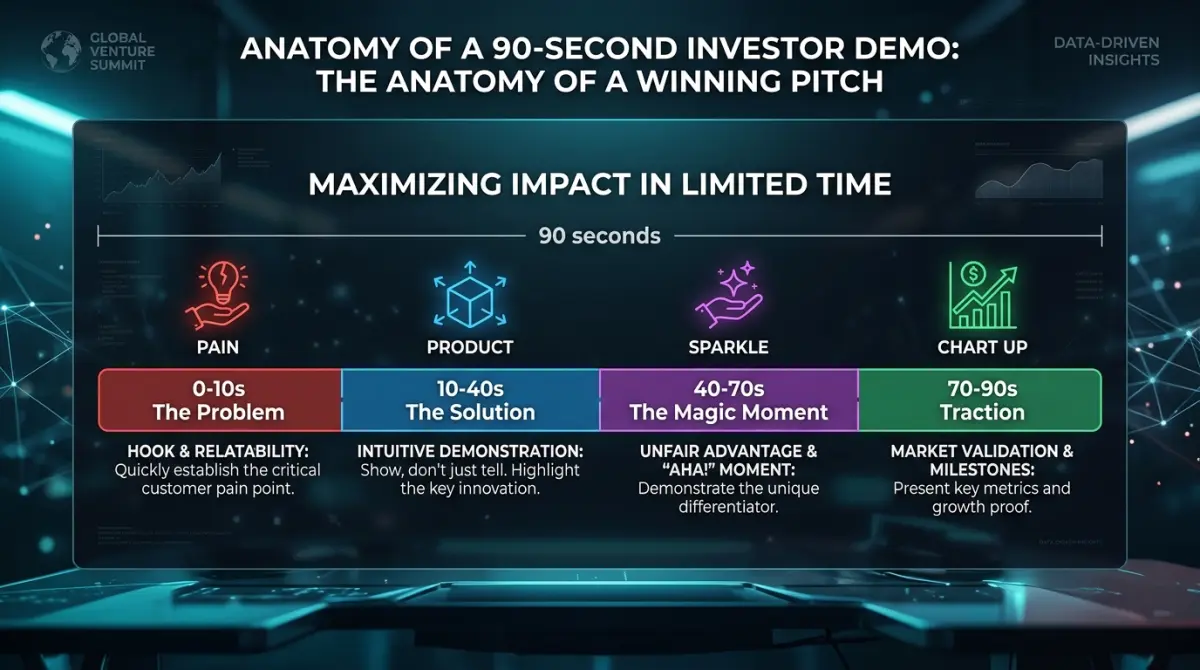
First 10 Seconds: The Problem (Show, Don't Tell)
Open on the problem. Not your logo. Not your tagline. The problem.
Show the ugly spreadsheet. The broken workflow. The error-prone manual process. Let the viewer feel the friction before you resolve it.
Script template: "This is how [target user] currently handles [task]. It takes [time/effort] and breaks when [common failure mode]."
No preamble. No "Hi, I'm Sarah, CEO of..." — investors already know who you are from the email. Start with the pain.
Next 30 Seconds: The Solution in Action
Now show your product solving the exact problem you just displayed. Same scenario, new tool. The contrast does the selling.
Keep the flow tight:
- One core workflow, start to finish
- No detours into settings or edge cases
- Real data (or realistic fake data), never placeholder text
- Let the product speak — minimize narration during the fast parts
The goal is to make the viewer think: "That was dramatically easier than the old way."
Next 30 Seconds: The Magic Moment
This is where you show what makes you different from every other solution. Your moat. Your insight. The thing competitors can't easily copy.
Maybe it's an AI feature that automates what used to be manual. Maybe it's a collaboration model that eliminates back-and-forth. Maybe it's speed that makes existing tools look broken.
Whatever it is, isolate it. Don't let it get buried in a feature tour. Give it the spotlight.
Last 20 Seconds: Traction or Social Proof
End with proof that this isn't just a good idea — it's working.
Options:
- Metrics overlay: "4,200 users in 3 months, 40% week-over-week growth"
- Logo bar: Show recognizable customer logos
- Quote: A one-liner from a customer or advisor
- Waitlist number: If pre-launch, show demand
Close with a single line: your ask or your next step. "We're raising a $2M seed to scale GTM. Let's talk."
Common Mistakes That Kill Investor Demos
Every week, VCs watch demos that could have been great but got sabotaged by the same avoidable mistakes.
Starting With Your Logo or Loading Screen
Your first frame matters more than any other. If it's a splash screen, a login page, or your company logo fading in — you've wasted the single most valuable moment in the entire video.
Fix: Hard-cut to the problem or the product already loaded. Edit out every second of setup.
Showing Every Feature Instead of the Core Flow
Founders love their features. All of them. This is a trap.
A demo that shows 12 features communicates nothing. A demo that shows one workflow executed brilliantly communicates everything. VCs extrapolate from quality, not quantity.
Pick the one flow that best represents your value proposition and make it flawless.
No Narration — Expecting Investors to Figure It Out
A silent screen recording is a puzzle, not a pitch. Investors shouldn't have to reverse-engineer what they're looking at.
Professional narration transforms a screen recording into a story. It guides attention, provides context, and controls pacing. Without it, your best feature might get scrolled past because the viewer didn't understand what they were seeing.
This is the single highest-ROI improvement most founders can make to their demos.
Over-Produced Videos That Hide a Weak Product
Investors have seen enough motion graphics to know when production value is compensating for product value. Fancy transitions and cinematic music don't build conviction — they erode trust.
The product is the star. Everything else is support.
How to Record Your Investor Demo
You don't need a video production team. You need a real product, a screen recorder, and a plan.
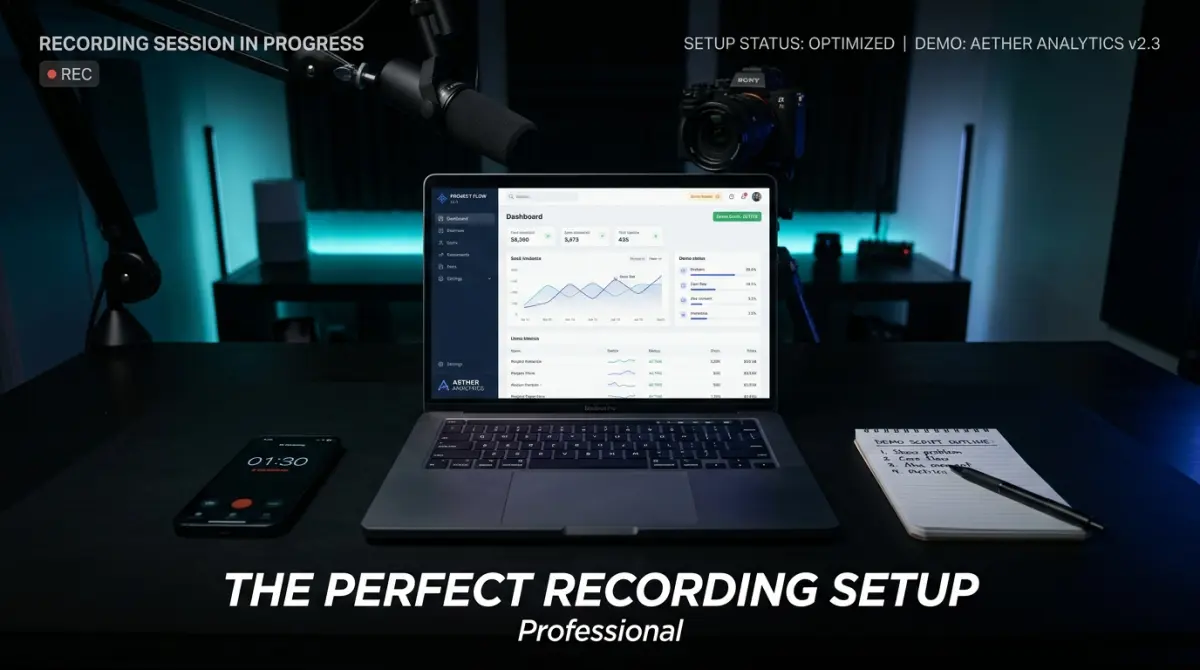
Step 1: Prepare Your Environment
- Clean your desktop. Close notifications, hide bookmarks, use a neutral wallpaper.
- Use realistic data. "Acme Corp" and "John Doe" signal prototype. Real-looking data signals real product.
- Pre-load everything. No page loads, no spinners, no waiting. Every second of loading is a second of lost attention.
Step 2: Record the Real Product
Screen record your actual product. Not a Figma prototype. Not slides with screenshots. The real thing.
Investors can tell the difference, and using the real product signals confidence. Record at 1080p minimum — a blurry demo looks amateur regardless of how good the product is.
Do 3-5 takes. Your best take will be the one where you made zero navigation mistakes and the flow felt effortless.
Step 3: Add Professional Narration
This is where most founders either skip the step entirely or spend days trying to get it right.
Worth knowing: Vorec is purpose-built for this — you upload your screen recording and AI generates narration that syncs with your on-screen actions. It produces professional voice-over in minutes instead of hours, which matters when you're iterating on your demo between investor meetings.
The key is that narration should guide, not describe. Don't say "now I'm clicking the blue button." Say "with one click, the entire pipeline runs automatically."
Step 4: Add Captions for Silent Autoplay
Your demo will be watched on mute more often than not. LinkedIn autoplay is silent. Email previews are silent. Partners forwarding your deck to other partners — silent.
Burn captions directly into the video. Not optional — mandatory. Tools like Vorec can generate synced captions alongside the narration, so you get both outputs from a single recording.
Step 5: Trim Ruthlessly
Your first cut will be 3 minutes. Get it to 90 seconds.
Every frame that doesn't advance the narrative gets cut. Every pause longer than half a second gets cut. Every "uh" and "so basically" gets cut.
The final video should feel like it was easy to make. That's how you know it's tight enough.
For a deeper walkthrough on the recording process, check out our guide on how to create a product demo video fast.
Where to Use Your Investor Demo
A great demo isn't a one-time asset. Deploy it everywhere.
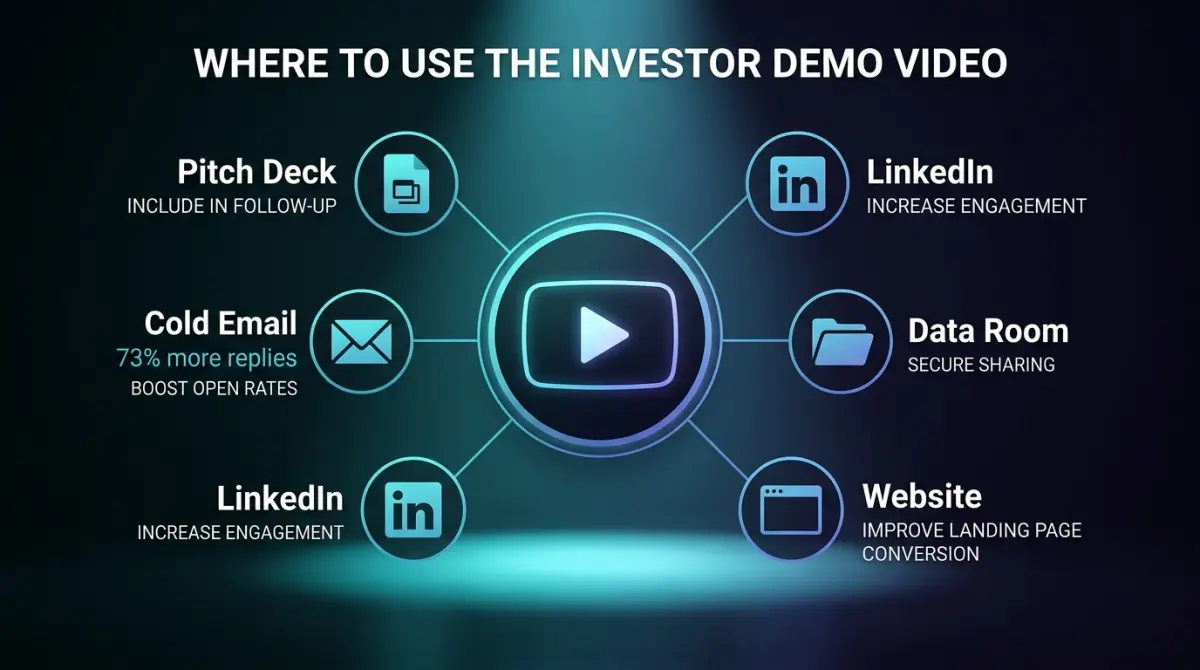
Pitch Deck
Embed your demo on slide 3 or 4 of your deck — right after the problem slide. The demo IS your solution slide. Don't make investors read bullets about what your product does when you can show them.
Use a Loom-style link or an embedded video. Never an attachment — file size kills email deliverability.
Cold Outreach
A cold email with a 90-second demo link converts 3-5x better than a cold email with a deck attachment. The demo is the hook. "Here's our product in 90 seconds" is a low-commitment ask that most investors will click.
Post your demo natively on LinkedIn (not as a link — native video gets 3x the reach). Caption it for silent autoplay. Your demo becomes content that attracts investors instead of you chasing them.
Data Room
Once you're in diligence, your demo belongs in the data room alongside your financials and customer references. Partners who didn't attend the live pitch will watch it. Make sure it stands on its own without your live commentary.
If you're timing your demo alongside a launch, our Product Hunt launch checklist covers how to coordinate demo assets across channels.
The Investor Demo Script Template
Use this structure as your starting point. Customize the brackets, keep the timing.
[0:00–0:10] The Problem "Right now, [target users] spend [time] doing [painful task]. Here's what that actually looks like..." → Show the messy status quo.
[0:10–0:40] The Solution "With [Product], that same workflow takes [shorter time]." → Walk through the core flow, start to finish. One take, no cuts.
[0:40–1:10] The Magic "But here's what really changes things..." → Isolate your differentiated feature. Slow down. Let it land.
[1:10–1:30] The Proof "[X] teams are already using this, including [notable names]." → Metrics, logos, or a customer quote. End with your ask.
Pre-Send Checklist
Before you attach that demo to your next investor email, run through this:
- [ ] First frame is compelling — no logos, loading screens, or login pages
- [ ] Problem shown in first 10 seconds — viewer understands the pain immediately
- [ ] One core flow, not a feature tour — you can describe the demo in one sentence
- [ ] Aha moment is obvious — a non-technical viewer would understand why this matters
- [ ] Professional narration — not silent, not rambling, not reading bullet points
- [ ] Captions burned in — watchable on mute with full comprehension
- [ ] Under 90 seconds — ideally 60-90 seconds, never over 2 minutes
- [ ] Real product, real data — no prototypes, no placeholder text
- [ ] Ends with proof + ask — traction metrics and a clear next step
- [ ] Tested on mobile — text is readable, UI elements are visible on a phone screen
- [ ] Link, not attachment — hosted URL that loads instantly, no download required
- [ ] Watched by someone outside your company — if they can't explain your product after watching, re-record
Your product might be great. But if your demo doesn't prove it in 90 seconds, investors will never find out. Record it, narrate it, trim it, and send it. The founders who raise aren't waiting for the perfect moment — they're shipping the demo that gets the meeting.
Ready to turn your screen recording into a narrated investor demo? Get started at vorec.ai.