Gemini Voice Remixing: Tune a TTS Voice by Text (2026)
Vorec Team · 2026-11-05 · About 9 min read
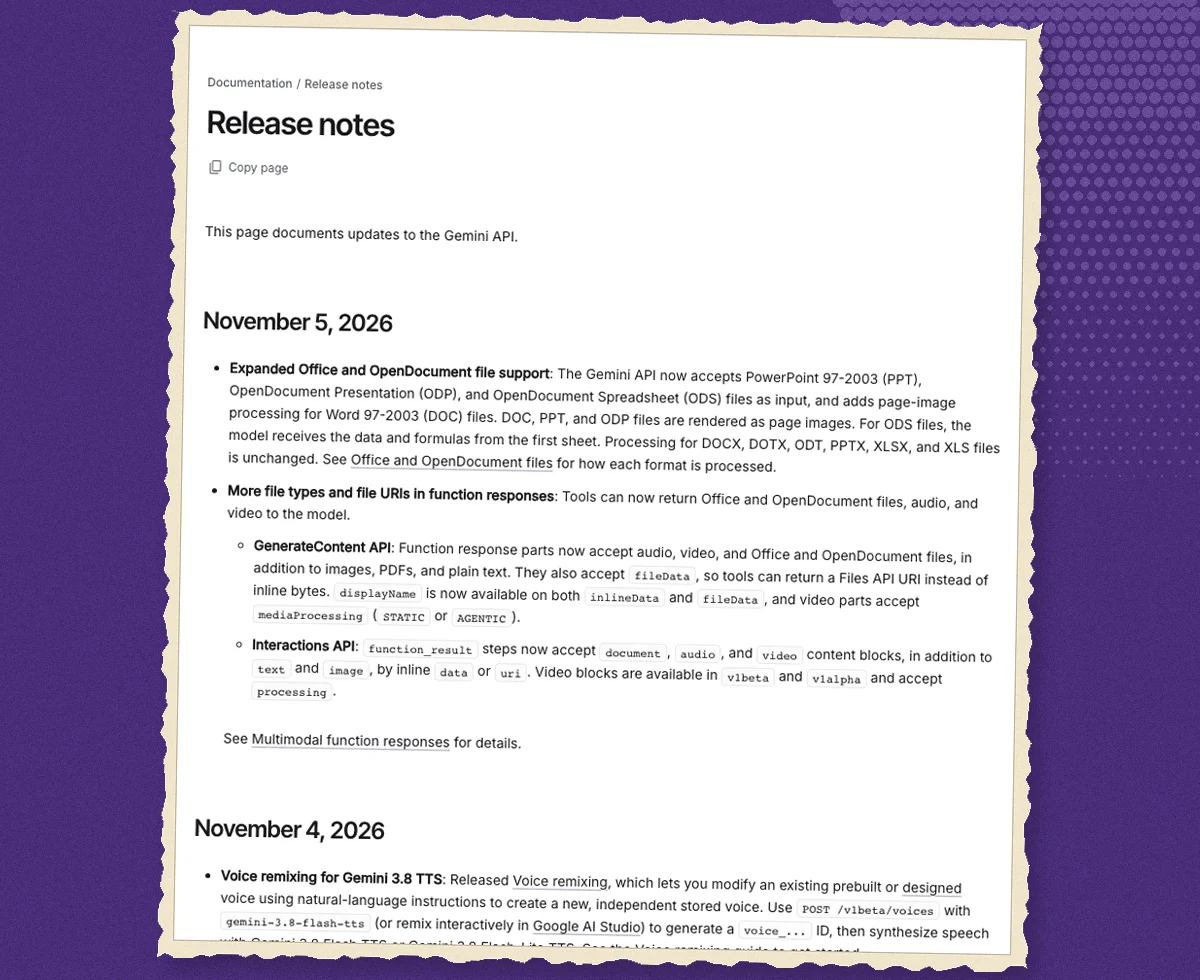
Gemini voice remixing is a Gemini API feature, recorded in Google's release notes on 4 November 2026, that modifies an existing text-to-speech voice with natural-language instructions and saves the result as a new, independent stored voice. You name a base voice, describe the change in a sentence, and get back a `voice_...` ID plus a WAV preview; the ID then works for speech synthesis with Gemini 3.8 Flash TTS and Gemini 3.8 Flash-Lite TTS. The original voice is untouched, remixes can be chained, a paid-tier project can keep up to 200 stored voices, and each one lives a year from its last use.
This page is built from six Google pages, all read on 5 November 2026: the Gemini API release notes, the Voice remixing guide, the Voice design guide, the speech generation guide, the Gemini 3.8 Flash TTS model page and the Gemini API pricing page. We haven't built a remix for this article; every capability below is as Google describes it, and where a sentence is our reading, it says so. Links to ai.google.dev currently redirect to aistudio.google.com.
What changed, and when
| Date (per Google) | Event |
|---|---|
| 22 September 2026 | Gemini 3.8 Flash TTS and Gemini 3.8 Flash-Lite TTS reach general availability, alongside a new Voices endpoint |
| 4 November 2026 | Voice remixing released for Gemini 3.8 TTS |
The 4 November entry says remixing lets you modify an existing prebuilt or designed voice using natural-language instructions, and points to the Voice remixing guide, the Voice design guide and the AI Studio speech page. The release note doesn't label the feature as preview or GA, and neither does the guide, so we're not labelling it either.
Three ways to get a custom voice
Google's TTS documentation now describes three routes to a voice that isn't one of the 30 prebuilt studio voices. They differ in what you start from.
| Route | You start from | You provide | Result |
|---|---|---|---|
| Voice design | Nothing | A text description of a persona (age, gender, timbre, accent, baseline delivery) | A new stored `voice_...` ID |
| Voice replication | A real speaker | Reference audio | A stored voice (or a stateless key) |
| Voice remixing | An existing voice | A base voice plus instructions describing relative changes | A new stored `voice_...` ID |
The remixing guide draws the line between design and remixing this way: design builds a persona from scratch, remixing anchors on a base voice and describes what should change. Voice replication, which copies a real person's voice, is a different feature with its own consent considerations; we cover that side in what is AI voice cloning.
How remixing works
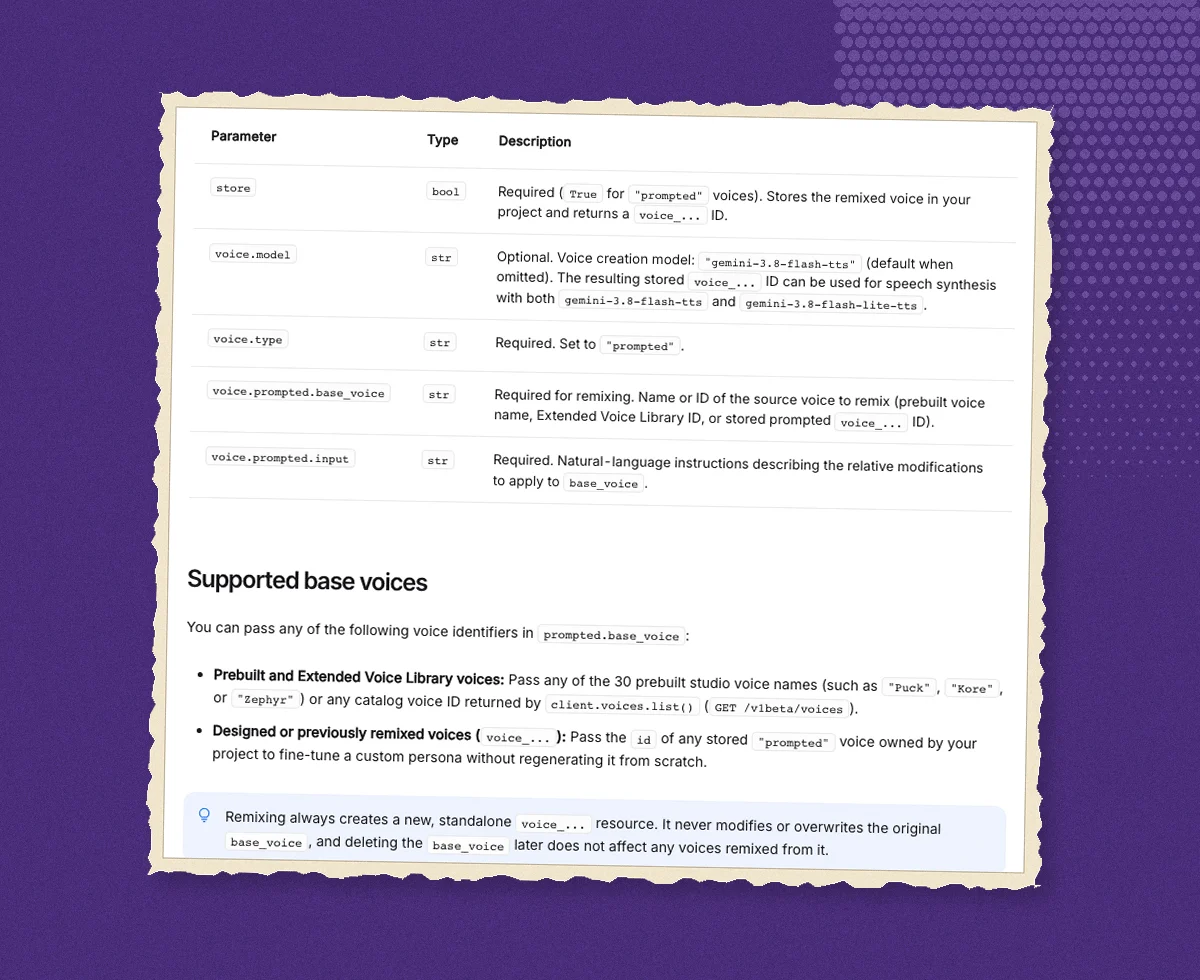
Per the guide, the API call is the same `POST /v1beta/voices` endpoint used for voice design, with these fields:
- `store`: `true`. Prompted voices have to be stored.
- `voice.type`: `"prompted"`.
- `voice.prompted.base_voice`: the voice to start from.
- `voice.prompted.input`: the instructions, in natural language.
- `voice.model`: optional; defaults to `gemini-3.8-flash-tts`.
The response carries an `id` beginning `voice_`, a `sample_audio` field containing a base64-encoded 24 kHz WAV preview, and the `prompted` metadata (base voice and input) so you can trace where a voice came from. `GetVoice` returns the preview again later. To use the voice, pass the ID in `speech_config` when generating speech, exactly as you would a designed voice.
Three details from the guide that matter in practice:
- The base can be almost anything. Any of the 30 prebuilt names (Puck, Kore, Zephyr and so on), any Extended Voice Library ID from the voices list, or a stored `voice_...` ID from a designed or previously remixed voice in your project.
- Remixes are independent. The original is not changed, and deleting it doesn't affect the remixed copies.
- Remixes chain. A remixed voice can be the base for the next remix, which is how Google suggests iterating.
Which models support it
Voice creation runs on `gemini-3.8-flash-tts`. The resulting ID synthesises speech on both `gemini-3.8-flash-tts` and `gemini-3.8-flash-lite-tts`. The speech-generation guide lists the older `gemini-3.1-flash-tts-preview` and `gemini-2.5-pro-preview-tts` as not supporting remixing.
The Gemini 3.8 Flash TTS model page, last updated September 2026, lists an 8,192-token input limit, a 16,384-token output limit, support for over 130 languages, and feature support for multi-speaker dialogue, voice design, voice replication and voice remixing. It doesn't state a maximum audio length.
Limits, retention and the paid-tier requirement
- Paid tier only. The remixing guide says it requires a paid-tier (Tier 1 or higher) Gemini API project.
- 200 stored voices per project, shared across designed, remixed and replicated voices.
- One year from last use. Each stored voice has an `expire_time`; synthesising speech with it, or using it as a base for another remix, resets the clock. Voices with no activity for a year expire.
- Language and accent are kept unless your instructions ask for a change.
- Not stated: an instruction length limit, a per-remix price, and whether the feature is in preview.
What Google's examples look like
The guide's examples describe relative changes rather than whole personas. One remixes the prebuilt Puck voice to sound older and more grounded with a British accent and audiobook pacing; another changes Kore's accent to Australian English while keeping a clear, confident delivery; a third adapts a designed voice for meditation narration by lowering projection and slowing the pace; a fourth raises energy to sound like a live event announcer. The iterative example keeps the speaker identity and accent but asks for a calmer, softer, slightly lower delivery.
Google's own best-practice list, paraphrased: describe relative changes to age, timbre, pitch, pacing and energy; keep the base language and accent unless you want them changed; change one or two traits per step when chaining, and listen to the preview before the next edit; and use remixing for lasting traits, leaving turn-by-turn delivery cues such as whispering or excitement to the `style` field in `speech_metadata`.
What it costs
We found no separate price line for remixing on the pricing page as of 5 November 2026 (check it yourself; it is long). Published TTS rates cover generated speech; the page does not state whether creating a remix incurs a separate charge. For speech generated with a remixed voice, the pricing page lists, for the standard tier:
| Model | Text input, per 1M tokens | Audio output, per 1M tokens | Equivalent per 10 s of audio |
|---|---|---|---|
| Gemini 3.8 Flash TTS | $0.50 through 31 Dec 2026, $1.00 from 1 Jan 2027 | $9.00 through 31 Dec 2026, $18.00 from 1 Jan 2027 | $0.00225, then $0.0045 |
| Gemini 3.8 Flash-Lite TTS | $0.50 through 31 Dec 2026, $1.00 from 1 Jan 2027 | $6.00 through 31 Dec 2026, $12.00 from 1 Jan 2027 | $0.0015, then $0.003 |
The page's footnote is the conversion: audio tokens correspond to 25 tokens per second of audio, so 10 seconds is 250 tokens, and 250 tokens at $9.00 per million is $0.00225. A five-minute narration (300 seconds, 7,500 audio tokens) on Flash TTS is therefore $0.0675 in audio output through the end of 2026 and $0.135 after the listed increase, roughly 7 and 14 cents, plus the text input tokens for the script. The free tier is listed as free of charge for standard requests, but remixing needs a paid-tier project, so the free tier doesn't get you a remixed voice.
What it means for tutorial narration
Our reading, separate from anything Google states:
- A consistent narrator across a series. Tutorial libraries are made of many short videos. A stored, remixed voice ID gives every video the same narrator without recording anyone, and because each synthesis with that voice resets its one-year expiry, a voice that is used to generate narration regularly stays available.
- A brand voice without cloning a person. Remixing starts from a prebuilt or designed voice, so a team can tune pacing and warmth for its product without the consent questions that come with replicating a colleague.
- Localisation with the accent you want. The guide's examples change accent explicitly; combined with the model's language coverage, that is the mechanism for a narrator who sounds local in each market rather than one voice read in several languages.
- Delivery is still a per-sentence job. Google separates lasting traits (remix) from moment-to-moment style (metadata). A tutorial needs both: the narrator's identity, and a slower, clearer read on the step that matters.
Vorec sits on the production side of this. It records your screen with its own macOS recorder, and an AI agent can drive it for you through the Claude Code plugin, capturing locally for you to review before anything is uploaded. It then drafts narration matched to the workflow it captured and generates the voiceover, so nothing is spoken into a microphone. In the editor you can add smooth cursor motion, cursor-follow zoom and click-based auto-zoom, and freeze-sync can hold a frame to give an explanation time to finish. The same capture can also produce a written step-by-step guide, with annotatable screenshots, and narration regenerates in supported languages on eligible plans, without re-recording. You can upload an existing recording instead if you already have one. Pricing, read live on 5 November 2026: a free trial, no credit card required (current allowances on the pricing page); paid plans are $9, $24 and $59 a month.
Frequently asked questions
What is Gemini voice remixing?
A Gemini API feature, released 4 November 2026, that takes an existing TTS voice and changes it with natural-language instructions, saving the result as a new stored voice with its own `voice_...` ID.
Which voices can I remix?
Any of the 30 prebuilt studio voices, any Extended Voice Library voice, or a stored voice you designed or remixed earlier in the same project.
Does remixing change the original voice?
No. The guide says the original is not changed and that deleting it does not affect remixed copies.
Do I need a paid plan?
Yes. The guide says remixing requires a paid-tier (Tier 1 or higher) Gemini API project. Generated speech is then billed at the TTS rates above.
How long does a remixed voice last?
One year from its last use. Generating speech with it, or using it as the base for another remix, resets the window; voices unused for a year expire.
Can remixing change the language of a voice?
The guide says remix prompts keep the base voice's language and regional accent unless you explicitly ask for a change, and its examples show accent changes. It gives no remixing-specific language list; the underlying Flash TTS model is documented for over 130 languages.
Related reading
For the models, voices and style controls, see Gemini TTS explained. For the other side of custom voices, see what is AI voice cloning. For how a narration voice is used, see what is AI narration and Eleven v4 for tutorial narration.
Want the recording to narrate itself? Record with Vorec, or upload one you already have, and get a narrated tutorial plus a written guide. Start free.